Get Full Government Meeting Transcripts, Videos, & Alerts Forever!
Get email alerts on the LD669 topic
No spam. Unsubscribe anytime.
Committee backs death benefit for MaineDOT workers; analyst to refine retroactivity and tax language
Summary
The Labor Committee voted to pass LD669 as amended to extend an indexed $100,000 death benefit to certain MaineDOT workers who die performing their duties, directing staff to refine retroactivity wording, beneficiary language and tax-exemption drafting with DOT and DAS input.
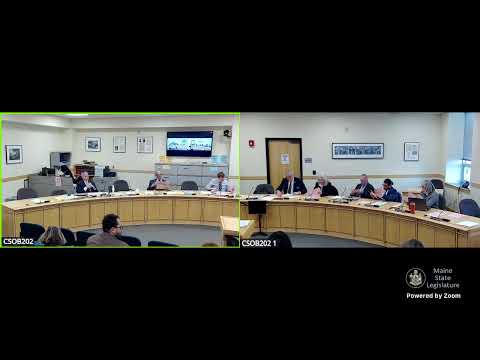
The Labor Committee voted to pass LD669 as amended, a bill to extend a state-paid death benefit to Maine Department of Transportation employees who die "in the line of duty." The committee endorsed draft two — which narrows coverage and uses unallocated language to identify named beneficiaries rather than broad retroactivity — and directed analysts to work with DOT and others on final drafting.
The measure, originally a concept draft sponsored by Representative Raider, would extend a $100,000 benefit indexed to inflation for covered MaineDOT workers; the analyst noted that indexing from July 1, 2021 yields about $118,152.91 as of June 30, 2025. "The amendment would allow a Maine DOT worker that has died while in the line of duty to receive a benefit payment of $100,000," the analyst told the committee during the work session.
Committee members pressed technical questions about how the benefit would interact with workers' compensation and how "in the line of duty" would be defined. Richard Hughes, general counsel for the Maine Workers Compensation Board, answered questions about existing workers' compensation death benefits: "Yes, there is" a death benefit, he said, explaining it is calculated as "500 weeks times the average weekly wage." Hughes also said workers' compensation benefits are "typically exempt from income taxes." The analyst told members the new death benefit is intended to be additional to workers' compensation and not an offset.
Maine DOT representatives offered two amendment alternatives: a broader draft covering all DOT employees and a narrower version targeted at highway maintenance workers working in the public right-of-way. Megan Russo, Director of Government Affairs at Maine DOT, said the agency can work with the committee on language and that rule-making by the Commissioner could further clarify coverage. "We were trying to determine: do we open this up for all DOT employees because we do operate a state ferry service?" she said, explaining the policy trade-offs in the two drafts.
The committee also discussed whether to leave the measure prospective or make it retroactive; the analyst recommended using unallocated language to name specific families (for example, the families of two recently deceased workers) if the committee wants to provide payments quickly without making the entire act retroactive. The Department of Administrative and Financial Services (DAS) suggested striking a statutory rule‑making mandate for the CPI calculation and recommended adding a tax-exemption clause limited "to the extent that the income is included in the federal adjusted gross income," language the analyst said could be inserted.
Following discussion, Senator Bradstreet moved to pass the bill as amended (draft two). The motion carried; the chair announced the measure passed "unanimous of all those present," and staff will finalize statutory language with input from DOT and DAS and correct identified typographical issues. The committee specifically agreed to remove the DAS rule‑making requirement related to CPI indexing and asked staff to prepare clean, legally precise language for the revisors' office.
The committee recorded no further votes on LD669 and left implementation details to the final drafting and rule-making processes.