Get Full Government Meeting Transcripts, Videos, & Alerts Forever!
Get email alerts on the Budget topic
No spam. Unsubscribe anytime.
Southern Columbia board weighs measures to close roughly $1.2 million budget gap
Summary
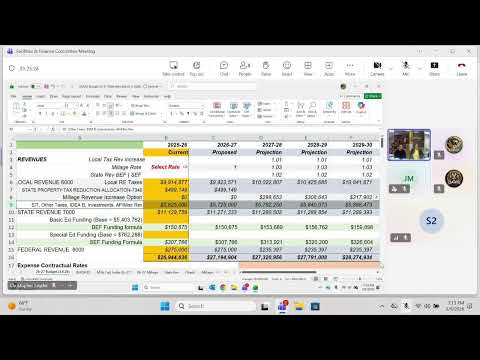
Finance staff told the board the draft budget shows about $27.194 million in revenue versus $28.4 million in expenditures (≈$1.2M shortfall). Members discussed one‑time solar credits, selling SREx, modest tax-collection increases, capital reserves and trimming expenditures as ways to narrow the gap.
A draft budget presented to the Southern Columbia Area School District board showed approximately $27.194 million in projected revenue and $28.4 million in proposed spending, leaving an estimated $1.2 million deficit under current assumptions.
Chris, the district's finance director, told the board that the numbers depend heavily on uncertain items such as state aid, interest income and one-time credits. "We are not putting any SRE revenue in here," he said, and recommended budgeting conservatively rather than assuming volatile income streams.
Board members and staff discussed a set of possible steps to reduce the gap. Measures under consideration included modest changes to collection assumptions (raising the tax-collection rate from the budgeted 96% to 97% was estimated to yield roughly $100,000), timing SREx (solar renewable energy credit) sales to market conditions, and maintaining capital-reserve contributions to avoid borrowing for future large projects.
Finance staff said the district expects a one-time solar tax credit (ITC) reimbursement of roughly $1.2 million, though the timing is uncertain. Chris urged treating that inflow as a one-time fix rather than recurring revenue. "If you call that a wash at $1.2 million, then the problem is next year," he said, urging prudence.
On SREx, staff warned market price variability and brokerage fees can affect proceeds. Chris said the district was piloting sales and recommended a conservative budgeting approach (for example, recognizing half of pilot receipts). "Earning the SREx isn't the problem. It's what the commodity market value is," he said.
On the expenditure side, the board discussed options including targeted reductions in nonessential supplies, careful use of capital reserve for qualifying projects and closer review of several contract categories where increases are anticipated. Contract negotiations for multiple bargaining units are ongoing; staff said changes would be incorporated into the budget only after ratification.
Members also discussed transportation routing efficiencies (to reduce bus runs) and continuing to fund security and capital projects at levels that avoid frequent emergency borrowing. Several members urged preserving capital reserve contributions to cover multi‑year items such as turf replacement and stadium projects rather than relying on one‑time revenues.
Next steps: staff agreed to refine the revenue and expenditure assumptions, provide a budget-to-actual comparison covering multiple prior years, and return to the board with tightened proposals before any final vote.