Get Full Government Meeting Transcripts, Videos, & Alerts Forever!
Get email alerts on the Elder Justice Communication topic
No spam. Unsubscribe anytime.
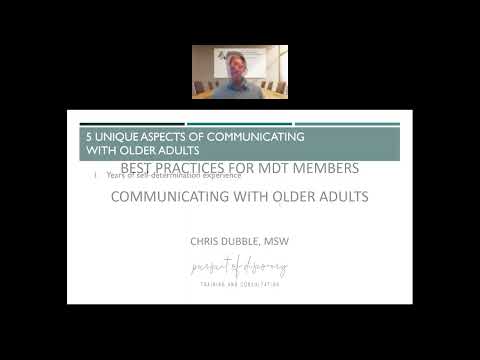
Trainer Chris urges MDTs to prioritize trust, concrete language and avoid 'elder speak' when working with older adults
Summary
Chris, a presenter with ties to Temple University, told multidisciplinary teams (MDTs) that pacing, trust-building, concrete wording (teachback, right-branching questions) and avoiding condescending 'elder speak' improve disclosure and outcomes for older adults.
Chris, a presenter who said he helped create Temple University’s Institute on Protective Services, told attendees that multidisciplinary teams should prioritize trust and concrete communication when interviewing and serving older adults. He framed the talk around two cautions—avoid broad generalizations and don’t rely solely on interview-style techniques—and offered practical tips he said are backed by research and decades of field experience.
Why it matters: Chris said older adults bring years of decision-making and different emotional goals to interactions, so practitioners who focus only on transactional information-gathering may get less accurate histories or disclosures. “Trust over transaction,” he said, urging teams to spend more time building rapport before moving to evidence gathering.
He listed common barriers that reduce clarity and cooperation: sensory changes (he noted about 50% of people 75 and older have significant hearing loss), environmental distractions, insufficient time, use of jargon, and assumptions based on age or stereotypes. To check comprehension, he recommended the CDC-endorsed teachback method—asking people to restate information in their own words—calling it both a trust-building and accuracy-promoting technique. “The teachback technique is simply where we say to the person, can you tell me in your own words what you heard me say to you today?” Chris said.
Concrete wording and question design were central themes. He advocated right-branching statements (place the main point first) to aid those with slowed processing speed, and urged teams to use specific, concrete phrasing for next steps (for example, describe who will come, when, and what they will do) rather than vague promises. He also warned against oversimplifying vocabulary to the point of patronizing; instead, mirror a person’s language level.
Chris described active listening practices and a posture acronym—SOLAR (sit squarely, open posture, lean forward, eye contact, relax)—as techniques to convey respect and reduce the likelihood of elderspeak, a sing-song or condescending tone. He cited a study result during the talk that, he said, found 96.7% of nurse interactions with patients diagnosed with dementia included some form of elder speak; he presented the figure to illustrate the pervasiveness of the problem and to urge colleagues to call out condescending behavior among peers.
He offered two concrete case examples. In one, an MDT confronted a son who had financially exploited his mother; rather than prosecuting, the team arranged restitution payments and supervised visits that preserved the mother’s emotional goal of reconciliation. In another, a certified nursing assistant unlocked cooperation from a combative resident by learning the man’s World War II shipboard role and reframing his interaction as relief from duty—an approach Chris summarized as using curiosity instead of pressure.
Chris closed by replaying two news clips of a woman he called Flossy: an initial segment that he said displayed dehumanizing handling and a later report from her 110th birthday at Fairchild Air Force Base that showed kneeling proxemics, respectful space, and active listening; in the later clip Flossy told reporters, “This is the greatest day of my life.” He told the audience that how people chose to communicate, not some innate change in Flossy, accounted for the different outcomes.
He encouraged attendees to attend a follow-up workshop for more practice, provided his email for follow-up resources, and turned the meeting back to Andy to close the session.