Get Full Government Meeting Transcripts, Videos, & Alerts Forever!
Get email alerts on the Police Discipline topic
No spam. Unsubscribe anytime.
Tennessee POST Commission decertifies former Johnson City officer Isabella Esposito
Summary
The Tennessee POST Commission voted to decertify former Johnson City Police Department officer Isabella Esposito after an internal-investigation summary found she had a romantic relationship with a man under investigation for selling cocaine, ran non-work NCIC/justice-portal queries at his request, and admitted misleading investigators.
The Tennessee POST Commission voted to decertify former Johnson City Police Department officer Isabella Esposito after an internal-investigation summary concluded she had a romantic relationship with a man who admitted selling cocaine and that she ran non-work-related criminal-justice database queries at his request.
Captain Andy Hossler, appearing for Johnson City, summarized the Internal Affairs inquiry. He said the investigation began after a confidential source and subsequent interviews tied Atello Gurido to cocaine distribution and identified Ms. Esposito as someone who had been in a romantic relationship with him. Hossler told the commission Esposito "admitted to having knowledge that Mr. Gurido was involved in the sale of cocaine" and that she had shared cell-phone locations with him during the relationship.
Hossler said investigators obtained text messages and interviews indicating Esposito and Gurido remained intimate into 2022 and that Gurido later admitted recent contact. The captain told the commission investigators also found Ms. Esposito ran at least one NCIC query and an Integrated Criminal Justice Portal query at Gurido's request and sent him a screenshot of a criminal-justice portal result. Hossler said Esposito "probably didn't have enough of a work-related reason to query the vehicle registration that Mr. Gurido had asked her to query." He identified potential violations including untruthfulness during the internal investigation, CJIS security violations and conduct inconsistent with the department's General Order 300.8 Code of Conduct. Hossler also said the department notified the district attorney and that General Finney issued a Brady letter concerning Esposito on Jan. 16, 2026.
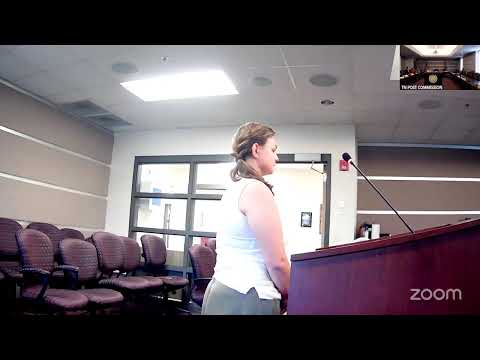
Esposito appeared before the commission and told members she was unprepared and had not retained counsel for the hearing. "I would like to apologize because I believe I misunderstood the process a bit here as I am very unprepared at the moment," she told the panel. She asked to decline some questions without counsel but acknowledged she had been re-interviewed and had admitted misstatements to investigators.
Commissioners debated whether to postpone the matter to allow counsel or proceed. After discussion, a motion to decertify Esposito was made, seconded and carried. The commission informed Esposito how to appeal the decision.
The commission's action is a certification decision based on the internal-investigation findings summarized at the hearing and Esposito's appearance. The commission did not hold a formal evidentiary hearing at this session; it treated the proceeding as an informal hearing under its stated process (no introduction of evidence or cross-examination). The commission recorded that appeal rights were available to Esposito.
Next steps: The commission provided procedural guidance on appeals. The transcript did not record a formal vote tally by name; the motion passed on the record.