Get Full Government Meeting Transcripts, Videos, & Alerts Forever!
Get email alerts on the Higher Education Finance topic
No spam. Unsubscribe anytime.
Minnesota committee hears bill to bar undocumented students from state financial aid; members lay it over pending fiscal detail
Summary
Lawmakers debated House File 1323, which would bar non‑citizens 'not lawfully present' from state financial aid and the NorthStar Promise program; testimony included competing views on fiscal impact and equity. The committee laid the bill over to await a finalized fiscal note and clarification of legal definitions.
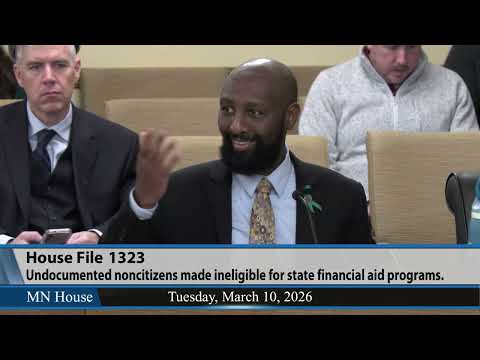
ST. PAUL — The Minnesota House Committee on Higher Education, Finance and Policy heard hours of testimony on House File 1323 on Wednesday, a bill that would make undocumented or otherwise not lawfully present non‑citizens ineligible for state financial aid including the NorthStar Promise program.
Representative Paul Schultz, sponsor of HF1323, said the measure would ‘‘clarify the eligibility requirements and ensure that tax dollars paid by Minnesotans ... are going to benefit those who have legal status.’’ He told the committee his estimate for fiscal‑year 2027 impact related to the programs discussed was about $2,762,000 and said roughly $2.7 million in the next school year was currently going to students he described as not lawfully present.
Supporters at the hearing argued limited state grant dollars should prioritize citizens and those lawfully present. Elliot Lindsey, who identified himself as treasurer of the College Republicans and a student, said the state has a large funding gap in its grant programs and that aid should be directed to Minnesota students who are legally eligible.
Opponents said the bill would strip access from students who were brought to the U.S. as children and who already must meet statutory documentation requirements to receive aid. The legislative policy director for the Minnesota Council on Latino Affairs testified that Dream‑Act‑type students are a small share of aid recipients (the witness estimated about 500 students) and that investments in those students yield economic returns for the state. A statewide student association policy director told the committee that denying access would exacerbate barriers for historically marginalized students and harm workforce development.
Committee members repeatedly pressed state higher education staff for data. Office of Higher Education staff said a final fiscal note for HF1323 had not been completed yet; committee discussion referenced a related fiscal figure for fiscal year 2027 of about $2,762,000, with an estimated $2,621,000 impact to the state grant program and some $23,000 projected for the NorthStar Promise program according to figures cited by staff during the hearing.
Members focused much of their questioning on statutory definitions — including whether students who have filed federal immigration applications (for example, for Special Immigrant Juvenile Status or asylum) would be treated as ‘‘lawfully present’’ for the purposes of the programs. House research and office staff explained that under the existing Minnesota statute implementing in‑state tuition and access provisions (often referred to in testimony as the Minnesota Dream or Prosperity Act), students without lawful immigration status may qualify for state aid if they meet several criteria, including documentation that they have filed an application for lawful status when a federal process exists.
Representative Hansen and others told the committee that under current law many eligible students already must show they have begun federal processes and that HF1323 could remove aid from students who ‘‘are doing everything they can do’’ to obtain lawful status. Representative Liebling said, ‘‘These students... are not responsible. They’re not lawbreakers,’’ and urged members to consider the public‑good rationale for investing in higher education. Representative Schultz responded that his bill is intended to focus taxpayer dollars on those the sponsor described as lawfully present.
After extended questioning about fiscal assumptions, definitions and intent, the committee altered its initial plan to send the bill to the General Register and instead voted to lay HF1323 over so members could receive the finalized fiscal note and additional data. No final committee vote on the merits of the bill occurred.
The committee also heard public testimony from students, campus groups and advocates on both sides of the issue. Multiple members asked staff to provide a clearer fiscal breakdown — how many students would be affected and how costs divide between state grant programs and the NorthStar Promise program — before further action.
Next procedural step: HF1323 was laid over by the committee pending receipt of the completed fiscal note and any additional materials the members request.