Get Full Government Meeting Transcripts, Videos, & Alerts Forever!
Get email alerts on the Reach Act Implementation topic
No spam. Unsubscribe anytime.
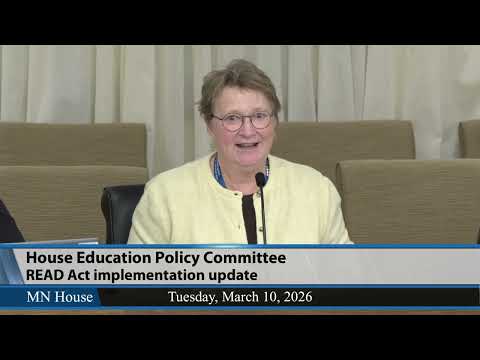
Committee hears progress and strains in REACH Act rollout; bill would require supervised early-literacy practicum for teacher candidates
Summary
State education officials told the House Education Policy Committee on March 10 that Minnesota has rapidly expanded teacher training and district screening under the REACH Act, but districts report funding, staffing and timeline strains. Representative Clardy’s House File 3421 would add a supervised field experience in early literacy to teacher preparation.
Bobby Burnham, commissioner for the Office of Teaching and Learning at the Minnesota Department of Education, told the House Education Policy Committee on March 10 that the state has built a regional infrastructure to support REACH Act implementation and has trained or is training the vast majority of educators required by the statute.
"The Regional Literacy Network became a lifeline to districts within the first year of operation," Burnham said, citing nearly 96,000 hours of professional development, coaching and implementation support provided to districts and charters in the network’s first full year.
Why it matters: The REACH Act (passed in 2023) sets statewide screening, curriculum-alignment and educator-training requirements intended to raise early-reading outcomes. State officials said universal screening and improved curriculum alignment create a baseline for targeting interventions earlier than the Minnesota Comprehensive Assessments can.
PELSB and the reading audit: Doc. You any Bailey, representing the Professional Educator Licensing and Standards Board (PELSB), and Dr. Lucy Pain, PELSB chair, described a three-step reading audit of teacher preparation programs. Bailey and PELSB staff said about 89% of programs have cleared the audit and 15 programs remain under review; agencies expect programs to reach compliance by June 30.
"We expect by June 30th of this year that programs will be fully compliant," PELSB staff said during the presentation.
District experiences and concerns: District leaders who testified said the reforms are showing early benefits but have created fiscal and scheduling strains at the local level. I maybe LeDoux, associate superintendent from Minnetonka Public Schools, said Minnetonka’s early grades saw progress after phase-one training but warned that new screener requirements and duplicative measures increase instructional burdens.
"Dual-language immersion screening adds complexity and future MDE guidance must reflect the research and unique context of these programs," LeDoux said.
Kimberly Smith, Hopkins district literacy lead and coordinator of a statewide grassroots group, said Hopkins has observed statistically significant gains where teachers received training but identified funding, shifting guidance and limited local capacity as barriers to consistent implementation.
House File 3421: Representative Clardy presented House File 3421, which would require that teacher candidates complete a supervised, evidence-based early-literacy field experience before licensure beginning with candidates in the 2027–28 school year. The bill would direct PELSB to do rulemaking and define which licensure areas require the field experience.
"Candidates won’t just learn the science of reading theory — they’ll learn to apply it with real students, receive actionable feedback and demonstrate competency before licensure," Representative Clardy said during her presentation.
Supporters at the hearing said supervised practice narrows the gap between coursework and classroom reality. Dr. Erin Gillette, a professor at Minnesota State University Moorhead, described a pilot in which teacher candidates tutor children and collect assessment data as authentic practice.
Committee questions and next steps: Members pressed agencies for additional detail about the audit’s layers (which programs only had a high-level review), the dates tied to waivers for graduates of cleared programs, and the timing of the MDE legislative report. MDE told the committee the legislative report is 95% complete and that collecting and cleaning the new universal screening data took extra time; a summary will be added to the report and posted soon.
Process note: An author’s amendment to House File 3421 was adopted by voice vote before Representative Clardy presented the amended bill. The committee laid the bill over for further consideration.
What’s next: Agencies offered to provide follow-up materials requested by members — program-level audit detail, the district-lead qualification breakdown from local literacy plans, and the finalized legislative report — and the committee signaled it may return to HF 3421 in a future meeting.