Get Full Government Meeting Transcripts, Videos, & Alerts Forever!
Get email alerts on the Transportation topic
No spam. Unsubscribe anytime.
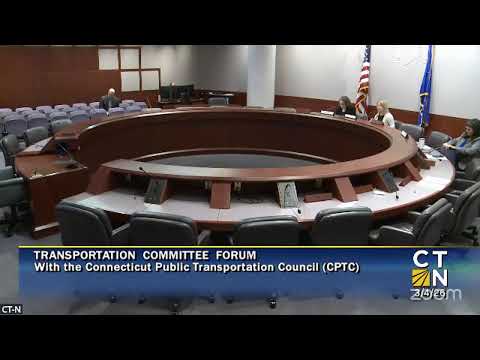
Connecticut Public Transportation Council urges rail expansion, better ADA compliance and coordinated snow‑removal
Summary
At an informational hearing, members of the Connecticut Public Transportation Council pressed state policymakers to invest in expanded rail service, fix fragmented complaint reporting at CT Transit, improve ADA compliance, and create coordinated snow‑removal plans to keep riders safe and accessible service reliable.
Members of the Connecticut Public Transportation Council told a legislative committee they want more steady, reliable service across the state's transit network, stronger enforcement and training around Americans with Disabilities Act requirements, and better coordination with municipalities on snow removal.
"With that 44% increase in service, it made the Waterbury branch the first branch that exceeded its pre‑COVID ridership," said Jim, a council member appointed by the governor, noting the line has climbed to "almost 150% of its pre‑COVID ridership" and attributing gains to steady service and recent funding. Jim also said a prior $5 million investment produced an immediate 28% ridership boost.
The council focused much of its testimony on two bills lawmakers are considering this session. Members said they support elements of Senate Bill 237 that would expand rail connections, including Danbury–Milford links and a potential Waterbury–Hartford connection, and they described Senate Bill 9's microtransit pilot as promising so long as it does not duplicate or displace fixed‑route service.
"Microtransit should not be cutting into fixed route service," Kate, a council member, told the committee, adding that the council is working closely with CT Transit and the Connecticut Department of Transportation on ADA accessibility and operator training. She said the council has asked the agency to aggregate complaint channels after finding "five to six different streams" for complaints that make it unclear how issues are handled end-to-end.
Snow removal emerged as a repeated concern. Chance Carter, who identified himself as the second vice chair of CPTC, said this past winter's heavy snowfall left riders standing on three‑to‑four‑foot banks and raised questions about municipal and state responsibility for clearing sidewalks and shelter areas. He urged coordinated work with councils of governments (COGs), municipal public works departments and DOT to create standardized, scaleable plans for clearing stops.
Lawmakers pressed the council on budgetary and operational questions, asking how the state should prioritize rail investments statewide and whether CPTC has data to show the effect of service increases on ridership. Jim said the council is compiling ridership statistics from lines that have received service increases and offered to share that data with the committee.
Council members also highlighted accessibility failures experienced by riders with disabilities and described plans to update training protocols and accountability measures for drivers and contracted operators. "ADA compliance is an afterthought," Kate said, adding the council is collecting video showing encounters in which riders with disabilities could not access buses or were subjected to extended confrontations with operators; she offered to share that footage with the committee as an instructional tool.
On service design, members pointed to work by outside advocates and regional studies'including proposals from an advocate named Casey Morin and the Move New Haven study'as useful blueprints for aligning local planning, transit districts and CT Transit operations.
The hearing concluded with members and legislators agreeing to continue coordination. CPTC said it will request aggregated complaint‑system data from CT Transit and DOT and that it will maintain quarterly meetings with the agency; lawmakers thanked the council and adjourned the informational session.
The committee did not take any formal votes during the session; next steps are follow‑up exchanges between the council, DOT and legislative staff to review requested ridership data, complaint‑handling aggregates and the council's ADA training materials.