Get Full Government Meeting Transcripts, Videos, & Alerts Forever!
Get email alerts on the Surveillance Pricing topic
No spam. Unsubscribe anytime.
Committee hears mixed testimony on bills to curb surveillance-based pricing in grocery and retail
Summary
Lawmakers considered two bills (HF 3408 and HF 3794) that would limit algorithmic or 'surveillance' pricing in grocery and retail; sponsors and consumer advocates urged action to prevent individualized price discrimination while retailers and business groups warned the bills could eliminate common discounts and impose heavy compliance burdens.
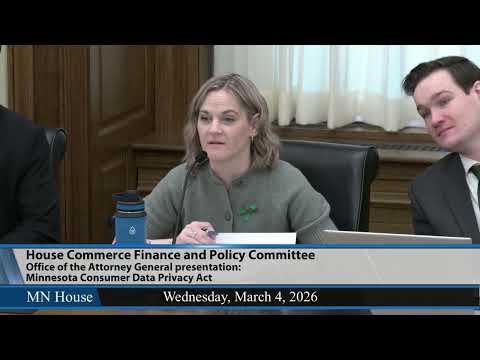
The House Commerce, Finance and Policy Committee heard hours of testimony on March 4 about proposals to curb so-called surveillance-based pricing in retail and grocery stores, including House File 3408 (Stop Grocery Surveillance Price Gouging Act) and House File 3794, which would broadly restrict automated systems used to set individualized prices and require disclosure and rebuttable presumptions for companies.
Representative Kotyza-witthuhn, sponsor of HF 3408, told the committee the bill targets "dynamic pricing algorithms" that companies could use to charge different customers different prices based on data and warned the practice could deepen market power imbalances. She said HF 3408 would bar retailers from setting individual prices based on consumer information, include narrow exceptions for group discounts (veterans, seniors) and loyalty programs, restrict the use of facial recognition in stores and limit electronic shelf label price changes to a 24-hour window.
Supporters, including Justin Stouffer of the Minnesota Farmers Union and Consumer Reports’ policy analyst Grace Kenney, argued that personalization can be opaque and unfair. Kenney said the group’s research and member accounts document examples where prices vary by browser, location or other signals and urged narrowly tailored exemptions to preserve traditional group discounts while preventing secret individualized price increases.
Retailers and technology vendors pushed back. A director of government relations for the Minnesota Grocers Association said electronic shelf labels (ESLs) connect to a storewide pricing database and do not use cameras or biometric identifiers; a senior vice president from a retail-technology vendor said ESLs do not personalize prices and cited an academic 2025 study that found no surge-pricing effects from ESL adoption. Retailers said some uses of data—such as loyalty discounts or same-day markdowns to move perishables—deliver consumer savings and argued the bills’ definitions risk sweeping in routine operational tools.
Committee discussion focused on points of drafting: how to define personalization versus market-driven price changes, how to craft exemptions for loyalty programs and group discounts, whether to allow limited emergency price updates, and how to avoid imposing disproportionate burdens on small businesses. Lawmakers also discussed the lack of full evidence of pervasive in-store individualized pricing, while others warned that emerging AI tools make proactive safeguards appropriate.
What the committee did: Members adopted technical amendments to both bills (expanding HF 3408’s scope to online grocers and adding burden-shifting language to HF 3794) and laid both bills over for further consideration and drafting work rather than advancing them to a committee vote for final passage.
Next steps: Sponsors said they will continue stakeholder consultation and drafting; the committee signaled interest in more technical fixes, fiscal estimates and clarifications about exemptions and operational impacts before a possible future vote.