Get Full Government Meeting Transcripts, Videos, & Alerts Forever!
Get email alerts on the Mobile Crisis Response topic
No spam. Unsubscribe anytime.
Dakota County officials urge $3.4M one‑time funding for mobile crisis teams
Summary
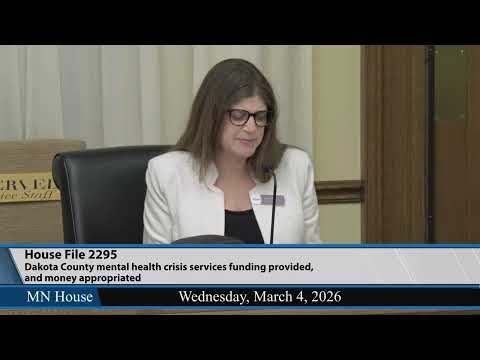
Dakota County lawmakers and county staff asked the committee to approve a one‑time $3.4 million appropriation to sustain mobile crisis teams and embedded social workers after ARPA funds expire, citing program data on call volume, diversions, and reduced repeat crises.
Representative (Dakota County author) asked the Human Services Committee to lay over House File 2295, a one‑time $3.4 million appropriation intended to bridge Dakota County’s mobile crisis response and embedded social‑work partnerships while the Department of Human Services completes a grant realignment.
"Mental health is a top community health concern in Dakota County," M Alicia, the county’s director of social services, told the committee. She walked the panel through the program’s recent outcomes: the county’s crisis team responded to nearly 20,000 calls in 2025, completed about 2,900 follow‑ups, delivered nearly 500 intensive therapeutic supports, and — since 2023 — diverted roughly 3,500 calls away from 9‑1‑1; 85% of diverted calls were handled without deploying law‑enforcement resources, according to Alicia.
Lakeville Police Chief Brad Paulson described a co‑response model in which officers and embedded social workers pair to stabilize crises and connect people to long‑term services. Paulson said the partnership served nearly 1,800 individuals in 2025 in a city of about 80,000 and offered an example in which repeated 9‑1‑1 calls from a single address (62 calls) fell by 80% after coordinated follow‑up.
County witnesses told legislators that the program has expanded into 11 local law‑enforcement agencies, that initial ARPA funding is expiring, and that the requested appropriation would bridge operations for a biennium while state grant formulas are reworked. Several members pressed county officials on sustainability, alternative funding options and whether this request simply shifts costs to property taxpayers; county leaders said they expect DHS grant changes to be the long‑term fix but sought a temporary state bridge to avoid immediate levy increases.
Committee members generally praised the model as a better alternative to default law‑enforcement responses, and Representative (Dakota County author) renewed a motion to lay HF 2295 over for possible inclusion. The committee laid the bill over without recorded roll‑call votes.
The committee will consider HF 2295 in omnibus negotiations; lawmakers and county leaders said they would pursue long‑term funding through DHS grant realignments and other sources if the requested bridge is not approved by the Legislature.