Get Full Government Meeting Transcripts, Videos, & Alerts Forever!
Get email alerts on the Program Implementation topic
No spam. Unsubscribe anytime.
Officials and community lenders describe slow rollout of Promise Act funds; about $72M reported unencumbered
Summary
DEED and nonprofit lending partners told a House committee that the Promise Act has disbursed awards and loans to thousands of small businesses but that a large portion of the appropriation remains unencumbered; partners detailed intake, verification and audit practices and said round‑2 work is ongoing.
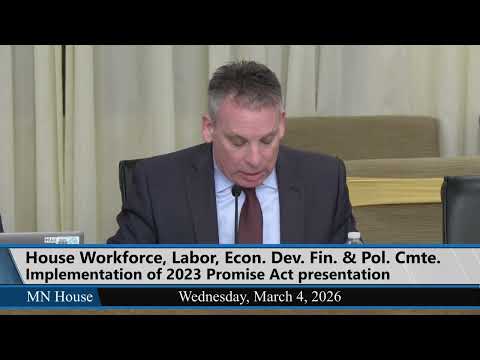
Deputy Commissioner Kevin McCann of the Minnesota Department of Employment and Economic Development told the House Workforce, Labor and Economic Development Finance and Policy Committee on March 4 that the Promise Act — enacted in 2023 and amended in subsequent sessions — has begun distributing grant and loan funds but that substantial funding remains to be deployed.
McCann said the statutory grant program went through a nine‑month set‑up with partners, opened a round‑one application window in mid‑2024 and closed awards in July 2025. He said partners and DEED reported roughly $22 million in grant awards made to about 1,235 businesses at the time of his slides, and that roughly $72 million of the grant appropriation remained unawarded. McCann also described a parallel loan program (a $30 million appropriation) and said about one‑third of that appropriation had been lent to date.
The committee heard consistent implementation descriptions from regional administrators, who said partners handle intake, eligibility screening and initial documentation verification before DEED conducts randomized audits. Mr. Ahmed, vice president of business services at Neighborhood Development Center (NDC), described an 11‑step applicant experience that includes eligibility confirmation, document upload, bank‑style identity verification, partner review and final DEED verification prior to disbursement. NDC said its round‑1 portal received more than 3,000 applications during a roughly 30‑day window and that it launched round‑2 in September 2025 to distribute a large share of metro grant funds.
Southwest Initiative Foundation President Scott Marquardt said demand in greater Minnesota was historically high during round 1: his office received 292 applications and awarded 41 grants across 18 counties. He urged allowing administrative discretion in specific cases (for example, to accommodate home‑based businesses or applicants using Schedule F farm returns) so that eligible businesses do not fall through technicalities. Greg Wagner of the West‑Central Initiative Foundation and other regional partners described similar patterns of strong demand and careful case‑by‑case vetting.
Partners outlined the allowed uses of grant funds (working capital, payroll, equipment, inventory and utilities) and reported an average grant size of about $18,000. DEED and partners reiterated that applicants must provide tax documentation (two to three years where available), photo identification, proof of operating address and bank information; partners then submit award determinations to DEED for final verification and payment.
Members on the committee pressed DEED for clearer public reporting. McCann acknowledged the award posting on DEED’s public site is incomplete in some fields and said a March 15 legislative report will provide the fuller dataset and details requested by legislators. He also reiterated that DEED reserves the right to perform post‑award audits and that it will do randomized verification sampling but has not yet directed partners to perform universal post‑award collection across all recipients.
The committee asked partners about implementation capacity and the difficulties facing applicants (document complexity, limited staff, digital literacy and short application windows). Partners said they have provided outreach and technical assistance to reduce application barriers, and that grantees may retain modest administrative and technical assistance percentages (partners may retain up to 5% for administration and 3% for technical assistance as allowed by statute).
The committee sought additional, longitudinal outcome data (Are awardees still in business? Were funds used as intended?). McCann said DEED expects to do follow‑up and audit work and will include relevant information in upcoming reporting. Chair Baker closed by asking for the March 15 report and further detail on ongoing monitoring and outcomes.
Ending: The committee paused formal votes and adjourned after requesting the March 15 legislative report with award‑level details and any recommendations for strengthening fraud referral and follow‑up processes.