Get Full Government Meeting Transcripts, Videos, & Alerts Forever!
Get email alerts on the Truck Platooning topic
No spam. Unsubscribe anytime.
Growers seek truck ‘platooning’ pilot; railroad safety concerns prompt layover
Summary
Representative Backer introduced a pilot (HF 3553) to allow leader–follower truck platooning on four Wilkin County routes serving sugar‑beet operations. Testimony from the grower cooperative said the technology has operated safely in North Dakota; Minnesota railroad representatives warned about grade‑crossing risks and called for more study. The committee laid the bill over.
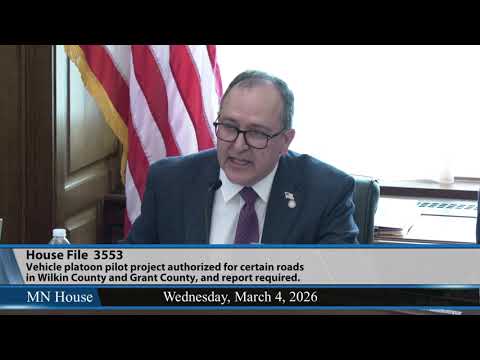
Representative Backer introduced House File 3553 as a targeted pilot to allow "leader–follower" truck platooning on four routes that serve sugar‑beet receiving stations in western Minnesota, emphasizing that a human would be present in each truck during the pilot.
The author said the proposal is modeled on operations just across the North Dakota border and is intended to help growers move harvests with fewer drivers available. "This would be a pilot project that will run on 4 specific routes in the district that I represent," the author said, adding that each platoon would include a human in every vehicle.
Dr. Mike Massacre, identifying himself as executive vice president of a sugar‑beet cooperative, told the committee the cooperative has used leader–follower platooning on the North Dakota side for years and reported extensive system testing and more than 100,000 miles in platoon operation without a moving‑violation or system failure. He described a staged "crawl‑walk‑run" deployment and said a human decision‑maker remains close enough to intervene in roadside contingencies.
Amber Backus of the Minnesota Regional Railroad Association urged caution. She warned that some of the proposed routes cross multiple active railroad tracks and said that, in a worst‑case scenario, a trailing vehicle failing to stop could leave two fully loaded trailers occupying a crossing. Backus cited existing Minnesota switching law and prior limitations that constrained platooning to divided highways with controlled access.
Committee members and the author discussed the bill’s scope and safety assurances. The author emphasized the bill is about permitting platooning with a human in each truck rather than changing size‑and‑weight rules. After testimony and some technical amendments were adopted, the author moved to lay the bill over for further work; the committee agreed to lay HF 3553 over pending follow‑up, including review of the fiscal note and route details.
The committee recorded no final vote to adopt the pilot as policy; the bill was held for further refinement and discussion.