Get Full Government Meeting Transcripts, Videos, & Alerts Forever!
Get email alerts on the Education Technology topic
No spam. Unsubscribe anytime.
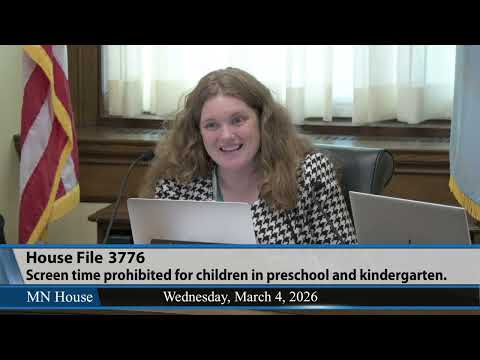
Committee weighs limiting screen time for Pre-K and kindergarten as parents and educators debate exceptions
Summary
The House Education Policy Committee heard testimony on H.F. 3776, a proposal to restrict screen time for Minnesota's youngest public school learners; educators warned a blanket ban could conflict with state standards and accessibility needs while child-development advocates urged limits.
The House Education Policy Committee heard competing views on a bill to restrict screen time for preschool and kindergarten students on March 4 during a session that included testimony from educators and child development advocates.
Representative sense or, the bill author, said H.F. 3776 was intended as "a conversation starter" about the effects of screen time on young learners and described concerns that device use has increased since the pandemic. "I think the evidence is there that they are the ones that are most negatively impacted by screen time," the author said, urging committee discussion rather than immediate mandate.
The bill would tighten when students in publicly funded preschool or kindergarten may use tablets or other digital devices and tie some uses to individualized plans.
Amanda Faye, executive director of technology for Minnetonka Public Schools, told the committee a blanket prohibition would conflict with existing academic standards and practical requirements. "A blanket prohibition on digital media...would create a direct conflict with existing state mandates and would take away the professional judgment of experienced and knowledgeable teachers across the state," Faye said, noting state English language arts and computer science benchmarks that require guided, standards-based digital work and the REACH one-to-one screening tools.
Faye said a ban would also remove universal accessibility supports such as speech-to-text, closed captioning and screen magnification that some students use without formal IEP or 504 documentation.
By contrast, Katherine Myers, co-founder and executive director of the nonprofit LIVE more screen less, urged limits on early screen exposure and cited research she said links heavy early use to delays in attention, language and social skills. Quoting older students her group surveyed, Myers said, "Technology can wait. Childhood cannot," and urged lawmakers to prioritize face-to-face learning time for youngest students.
Committee members pressed on implementation details: whether districts can already impose bans, how IEP and 504 exceptions would be handled, and whether parental opt-outs are feasible. Nonpartisan staff and MDE staff answered that districts can adopt phone policies but must manage exceptions for medical or accessibility needs and that existing statutes and the REACH screening requirements create practical constraints.
Chair Jordan laid H.F. 3776 over for further discussion, signaling additional work is needed to reconcile classroom practice, statutory standards and parental concerns before any final action.
The committee did not take a final vote on the bill; further hearings were anticipated.