Get Full Government Meeting Transcripts, Videos, & Alerts Forever!
Get email alerts on the Sustainability topic
No spam. Unsubscribe anytime.
Roseville Area Schools honored with Minnesota GreenStep Schools recognition; board outlines waste, stormwater and solar plans
Summary
Roseville Area Schools and Roseville Area High School received Minnesota GreenStep Schools recognition. District leaders detailed solid-waste, stormwater and solar initiatives, classroom uses of live solar data and next steps for student engagement and phased program rollouts.
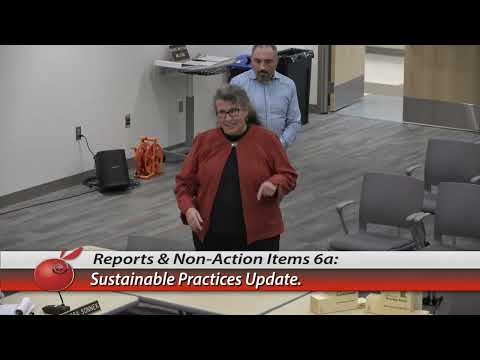
Roseville Area Schools accepted Minnesota GreenStep Schools recognition and used the board meeting Tuesday to update the community on district sustainability work, including standardized single-stream recycling, a phased compost pilot at elementary schools, stormwater best-management practices and curriculum that puts live solar-data into classroom lessons.
Director Sher Thompson introduced the district’s Green School steering committee and said the award recognizes both the district and the high school for completing foundational steps of the GreenStep Schools pilot. A GreenStep Schools representative told the board the Level 1 requirements include a board resolution to participate, formation of a Green Team, regular meetings and documenting the district’s sustainability story so other schools can learn from it.
“Being first takes leadership,” the GreenStep representative said, praising students and staff for their work in developing the program. Thompson and steering-committee members also highlighted partners, including Ramsey County and the City of Roseville, which helped with stormwater projects and other infrastructure work.
On solid-waste management, presenters described a shift to standardized single-stream recycling containers to reduce contamination and said recyclable material goes to a local MRF (materials-recovery facility) for sorting. They emphasized the district’s food-recovery approach — prioritize feeding people, then animals, then composting — and said the compost pilot is in place across elementary schools; secondary rollout awaits adequate staffing and operational supports. Presenters noted ongoing kitchen upgrades, including newer dish machines, that make reusable trays and flatware feasible; district staff said the investment is roughly break-even and creates local labor opportunities.
The board heard about three stormwater strategies in use across district sites: above-ground retention ponds, subsurface infiltration under parking areas, and engineered filtration BMPs. The BMP installed at Parkview requires annual filter maintenance and was completed in partnership with Ramsey County, City of Roseville and Capitol Region Watershed, presenters said.
Presenters also discussed solar prospects. Falcon Heights Elementary’s roof is currently fully occupied and is not a candidate for additional panels; the district plans roofing projects at Ed Williams Elementary next summer that could open opportunities for solar installs where financially and technically feasible.
Megan Ronnie, a district science teacher, described how students have used live solar production dashboards in class to analyze kilowatt-hour generation, monthly outputs for 2024 and environmental benefits. Ronnie said district materials estimate the solar system has avoided "about 1.7 million extra pounds of CO2," which the presentation framed as roughly equivalent to planting nearly 13,000 trees. “Students are surprised the panels aren’t visible from the ground, and they enjoy analyzing the real-world data,” Ronnie said.
Board members asked about field trips to the MRF and compost facilities and discussed expanding the curriculum lessons beyond the school with the solar arrays. Presenters welcomed those ideas and said steering-committee lessons and materials can be shared districtwide and with community-education programs.
Longer-term topics flagged for study include electric buses and further facility retrofits. Thompson said the district will move into Step 2 of the GreenStep process and continue quarterly steering-committee work to track implementation and next steps.
The board closed the sustainability discussion by thanking students and volunteers for leading the effort and by committing to continue integrating sustainability into district planning and curriculum.