Get Full Government Meeting Transcripts, Videos, & Alerts Forever!
Get email alerts on the Transportation topic
No spam. Unsubscribe anytime.
District transportation review highlights safety record, propane bus purchases and tech pilots
Summary
The district’s transportation director presented a program evaluation citing 28 consecutive years of ≥90% inspection results, $343,000 in grants to buy two propane buses, on-board cameras and GPS, and recommendations to pilot student scan-on/scan-off IDs and run summer route samplers before finalizing fall routes.
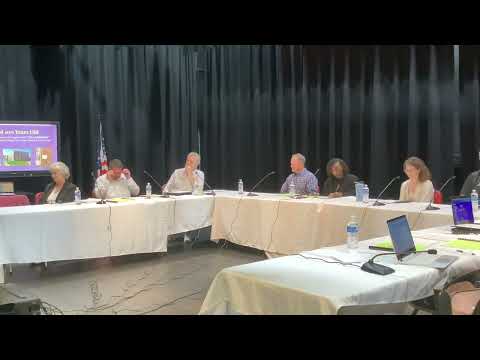
The district’s transportation staff presented a program evaluation that emphasized safety, training and recent investments in cleaner-fuel buses and vehicle technology.
Scott, introduced as the district’s transportation representative, said the department has achieved 28 consecutive years meeting the state’s top inspection standard (90% or better) and described a regional training program that now serves neighboring districts and municipal employees. He credited staff including Laura McAfee and others with spearheading training and preventive maintenance programs that he said helped keep the district’s inspection defect count to 16 buses over the 28‑year span.
Scott told the board the department has added live-stream cameras, GPS tracking, Wi‑Fi, in‑vehicle tablets and student-tracking capability to improve safety and operational oversight. He said the district also secured approximately $343,000 in grant funding that allowed it to acquire two propane-powered school buses outright and to offset infrastructure costs for fueling conversions.
On fuel economics, Scott said propane buses generally show reduced miles-per-gallon compared with diesel—“roughly between 23 and 40%,” he said—but that lifecycle comparisons, grant support and lower emissions can produce net savings and health benefits for students waiting at stops. He declined to provide an exact MPG figure off the top of his head and said the range was a high-level estimate.
Recommendations included continuing to pursue targeted route reductions tied to retirements to avoid layoffs, piloting student ID scan-on/scan-off capability on a small number of buses before a wider rollout, conducting summer sample routes for families who requested stop previews, and continuing cooperative training with first responders for emergency response scenarios. Scott said a National Association for Pupil Transportation (NAPT) safety evaluation and further TSA cooperative training are planned if funding is available.
The presentation also described partnerships and grant-writing work with local organizations (Big River Oil, Continental Cement, regional transportation associations and local police and fire departments) that the transportation staff said were crucial to the recent purchases and training programs.
The board asked several operational questions about fuel costs and maintenance tradeoffs; Scott acknowledged that precise cost comparisons vary with market prices and that some data (exact MPG differential, detailed per-bus cost breakdowns) were not on hand in the meeting packet.