Get Full Government Meeting Transcripts, Videos, & Alerts Forever!
Get email alerts on the Juvenile Justice topic
No spam. Unsubscribe anytime.
Maryland Senate debates youth‑charging reform bill and rejects amendments to preserve more adult auto‑charges
Summary
Senate debate on SB323 focused on whether certain serious offenses — including first‑degree assault and firearm‑related drug offenses — should still automatically begin in adult court for older minors. Lawmakers discussing statistics about Maryland’s auto‑charging practice and juvenile services clashed over public safety and racial‑disparity arguments; the Senate rejected several amendments and ordered SB323 printed for third reading.
The Maryland Senate spent much of its March 4 session debating Senate Bill 323, the Juvenile Court Jurisdiction — Youth Charging Reform Act, which would shift many offenses that now automatically start in adult court so they begin in juvenile court for older minors.
Senator from District 4 moved a floor amendment to retain first‑degree assault among the offenses that would start in adult court. The senator argued first‑degree assault “is just short of homicide, attempted murder” and said young people armed with handguns who commit such assaults should start in adult court. "Anybody that's carrying a gun ... that hospitalizes and creates a serious bodily injury or threat of death should go to auto‑charging and should be heard directly in front of a judge," the senator said.
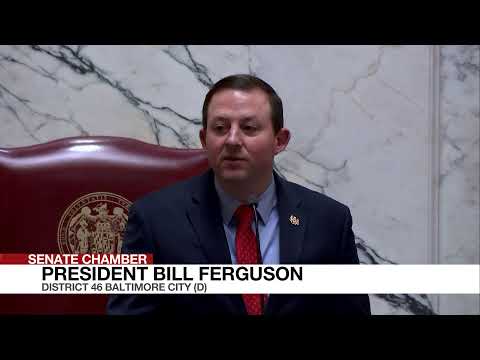
Supporters of SB323, including the chair of the Judicial Proceedings Committee and the floor leader, urged rejection of that amendment and others offered during the day. In a lengthy floor explanation, the committee chair said Maryland “is an extreme outlier” in sending youths into the adult criminal system, cited federal separation requirements under the Juvenile Justice and Delinquency Protection Act (JJDPA), and described racial disparities in current auto‑charging practice. "Nine out of 10 of those youths automatically charged as adults are children of color," the chair said, arguing the bill would improve access to services and produce better public‑safety outcomes.
Lawmakers questioned the data and tradeoffs at length. One senator cited figures — echoed in floor exchanges — that "80 to 85% of the cases that automatically start in the adult system ultimately make their way back to the juvenile system," a point proponents used to say starting in juvenile court avoids wasted time in adult facilities. Opponents countered that a significant minority of first‑degree assaults are never waved down to juvenile court and said the bill could leave victims and communities exposed in some cases.
The Senate held roll calls on multiple amendments. A District 4 amendment to retain first‑degree assault as an automatic adult charge failed on the roll call, with the clerk reporting 27 votes in the negative. A minority‑whip amendment to exclude firearm‑related drug offenses from the bill also failed (clerk reported 30 votes in the negative). A separate amendment intended to require that second or subsequent listed offenses auto‑start in adult court was rejected as unnecessary (clerk reported 26 votes in the negative); committee leadership said current statute already addresses conviction‑based escalation. A later amendment seeking explicit reporting by the Department of Juvenile Services on diversion program participation and a mechanism for courts to reinstate petitions when youths violate diversion terms was debated at length and ultimately rejected on a roll call.
Throughout the debate, senators pressed officials and one another on concrete data, diversion practices, and whether problems stem from statute, judicial practice, or Department of Juvenile Services administration. Proponents of the bill said previous reforms and expanded reporting are already on file with the Department of Legislative Services (DLS) and that SB323 builds on those changes; critics said greater, timely reporting to legislative committees and more explicit statutory guardrails would improve accountability.
With no further amendments, the Senate ordered SB323 printed for third reading. The bill will return for a future third‑reading vote as the standard legislative process continues.
The chamber then proceeded to consider other calendar items and adjourned, with the Senate set to reconvene March 5 at 10 a.m.