Get Full Government Meeting Transcripts, Videos, & Alerts Forever!
Get email alerts on the Flood Mitigation topic
No spam. Unsubscribe anytime.
CRA board prioritizes backflow preventers as near-term fix for Central Beach flooding; larger street-raising and pump projects await FDOT agreement
Summary
After staff presented an evaluation of backflow preventers, street‑raising options and pump‑station needs for Central Beach, the CRA board signaled support for installing redundant backflow valves (estimated $1.3 million) as an immediate measure and asked staff to bring procurement and an April authorization while urging an interlocal agreement with FDOT before pursuing larger $6.4M–$21.3M infrastructure work.
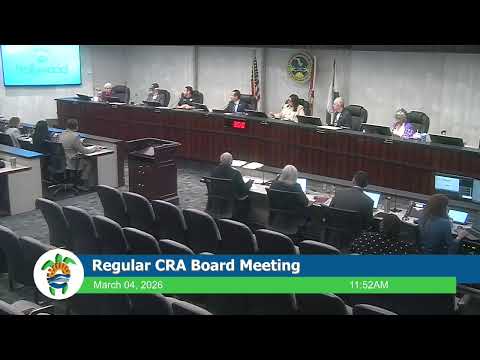
Hollywood CRA executive board — At a regularly scheduled CRA executive board meeting, staff and the city’s stormwater consultant outlined a phased approach to persistent tidal flooding in the Central Beach district, and board members coalesced around installing redundant backflow preventers as the immediate priority while deferring large-scale street‑raising and pump‑station spending until intergovernmental terms are clarified.
Sarita Sharma, senior project manager for the Hollywood CRA, told the board the CRA obtained a contractor estimate to install redundant backflow valves (commonly called "whoppers") at east–west street outfalls; the turnkey estimate for the remaining installations is about $1.3 million, Sharma said, and four devices have already been installed. Raising the lowest six street profiles to deliver localized improvement was estimated at roughly $6.4 million; a comprehensive pump‑station program discussed in the presentation carries an estimated $21.3 million price tag and depends on coordination with Florida Department of Transportation (FDOT).
"Installing these whoppers is a very efficient way to control localized flooding," Sharma said during the presentation, summarizing the in‑house CRA analysis and the GIS and stormwater data used to narrow priorities. John Goldman of CDM Smith, the city’s stormwater engineer, emphasized the tradeoffs: backflow preventers can provide quick relief for king‑tide inundation and are relatively inexpensive to deploy, but they require annual maintenance and do not stop groundwater seepage. "If you raise it 12 inches, then you've gained 12 inches," Goldman said, describing how street‑raising buys elevation but must be harmonized carefully with adjacent private properties.
Public commenters and several board members pressed for FDOT engagement. Resident Bob Glickman urged the board to press FDOT to repair flap gates and underground piping on the Intracoastal, arguing those repairs would address a primary cause of backflow; he also raised neighborhood curb and catch‑basin details that can trap water on side streets. Board member Hernandez warned that removing curbs to improve flow risks displacing water onto private property; she and other members recommended staff pursue an interlocal agreement with FDOT before committing CRA funds to large pump‑station construction.
Board members generally supported the staff recommendation to prioritize backflow preventers as a near‑term, cost‑effective step and directed staff to return with procurement and implementation steps. Staff said it could bring a resolution for authorization at the April CRA meeting and continue to press FDOT in advance of the FDOT secretary’s planned appearance at next month’s meeting.
Next steps: staff will prepare procurement and a formal authorization for backflow preventer installation for the board’s April consideration, continue FDOT coordination for potential cost‑sharing or reimbursement, and proceed with follow‑up studies (detailed surveys and harmonization designs) before advancing larger street‑raising or pump‑station projects.