Get Full Government Meeting Transcripts, Videos, & Alerts Forever!
Get email alerts on the Environmental Resiliency topic
No spam. Unsubscribe anytime.
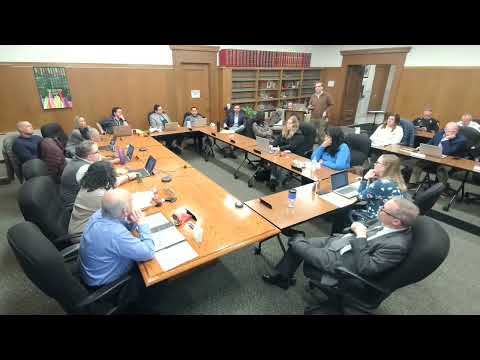
Moline City Council hears environmental resiliency plan update; consultants flag electricity as largest local emissions source
Summary
Consultants from Blue Strike updated the Moline City Council on an environmental resiliency plan targeting adoption in June 2026, presenting preliminary 2024 greenhouse‑gas inventories that show electricity as the largest emissions sector and municipal operations accounting for a small share of total emissions.
Consultants visiting from Blue Strike presented a progress update on Moline’s environmental resiliency plan and answered council questions about inventory results, priorities and barriers to implementation.
Anna Bugan Kova, a Blue Strike presenter, described the plan’s deliverables as an emissions inventory, a communitywide framework, a vulnerability assessment and a set of pollution‑reduction and resilience strategies. She said the team expects to finish community outreach in late winter, draft strategies beginning in March and seek plan adoption in June 2026.
The consultants showed preliminary greenhouse‑gas inventories for 2024 and emphasized that the numbers remain subject to refinement. “This is still work in progress—we’re still working on refining those inventories,” Anna Bugan Kova said. The consultants explained two inventories: a communitywide inventory (all emissions inside city limits: residential, commercial, industrial) and a municipal inventory (city‑owned facilities and operations).
During questions, presenters said municipal operations represent a relatively small portion of total citywide emissions; when asked, the presenter stated municipal operations account for about 3% of total emissions. Council members pressed on sector breakdowns and were told electricity is the single largest contributor in the preliminary inventory (discussed in the meeting as roughly 70% of the community total), followed by transportation and fossil fuels (primarily natural gas).
Council members asked whether a proposed power plant in nearby Scott County would affect Moline’s electricity‑sector numbers. Consultants said it could, depending on where the city’s supplier purchases generation: “If Mid‑America is buying a lot of carbon‑intensive generation, that will show up in this electricity sector,” a presenter said, and recommended that the city follow up with the utility to understand feeder and generation sources.
Discussion turned to resilience priorities and visible, near‑term steps. Council members and consultants identified low‑cost, demonstrable actions—rain gardens, more visible street and downtown landscaping, planting diverse and younger trees—and municipal demonstration projects (solar on city buildings, efficiency upgrades) that can lead by example. Several speakers proposed a program to help homeowners remove hazardous trees after severe storms, including possible city hiring with a bill‑back mechanism through utility or assessment payments.
Speakers also discussed resiliency hubs—community sites with battery storage, charging and communications capacity to support recovery after outages—and urged that hubs be distributed in size and location so the whole city does not converge on a single site.
Council members and consultants listed barriers to implementation: funding and tax implications, staff capacity and training, regulatory constraints, and the need to build public trust. Presenters recommended packaging proposals to highlight tangible benefits (cost savings, quicker recovery) and partnering with trusted local groups and schools to extend outreach.
The council received the update; no formal vote on the plan was recorded during this portion of the meeting. Consultants noted public workshops, steering‑committee input and additional surveys will continue to shape the strategy and recommended continued coordination with the city’s utilities to validate electricity‑sector assumptions.
What’s next: consultants said outreach will continue, strategy drafting begins in March, and the team is targeting plan adoption in June 2026.