Get Full Government Meeting Transcripts, Videos, & Alerts Forever!
Get email alerts on the Land Use topic
No spam. Unsubscribe anytime.
County attorney: zoning decisions must rely on the record; several zone‑map actions advance
Summary
Franklin County's attorney told the fiscal court that rulings on zone changes must rely on the administrative record or formal hearings; the court advanced multiple zone‑map items, approving two second readings and taking first readings on others.
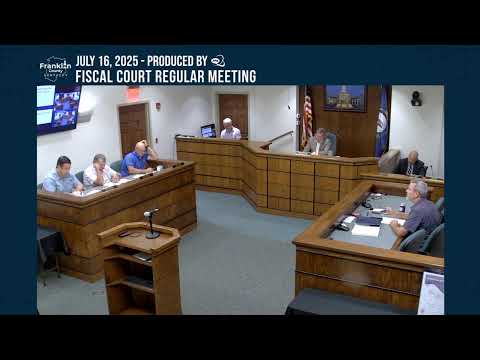
Franklin County’s county attorney cautioned the fiscal court on July 16 that decisions about zoning map amendments must be based on the administrative record — testimony forwarded from the planning and zoning commission or evidence offered on the record at a court hearing — and warned that considering testimony not on the record could make an approval subject to judicial overturn.
"If it's not on the record, then the court cannot consider it," the county attorney said during a Q&A meant to clarify when residents may ask the court to hold a special hearing. He added that asking the court to schedule a hearing (without offering new testimony that should have been part of the planning commission record) is permissible, but accepting new evidence outside the record risks later reversal in court.
The advisory clarification preceded a series of land‑use items on the agenda. The court took second‑reading votes to approve two zone‑map amendments: a 7.67‑acre portion at 1373 Peaks Mill Road from Agricultural (AG) to Rural Residential (RR), and approximately 135 acres at 650 Evergreen Road from Rural Residential to Agricultural. Several other requests were presented as first readings (including a proposed PO→IG change for 190 Democrat Drive and a RR→CG request for 1120 Ducker Road); the court did not take final action on first‑reading items.
Commissioners discussed procedure: multiple members said they will use the first reading to request a separate public hearing if constituents make substantive new claims or if they believe the record lacks material information. Staff reiterated that starting a hearing on the first reading is the appropriate way to create a record and that hearings require transcript and legal process.
What happens next: The two items that completed second reading were adopted by ordinance per the court’s vote. First‑reading items remain on the docket for future action; commissioners may call for hearings at the first reading if they desire additional testimony to be formally recorded.