Get Full Government Meeting Transcripts, Videos, & Alerts Forever!
Get email alerts on the Financial Literacy topic
No spam. Unsubscribe anytime.
Credit Union of Texas and Richardson ISD highlight student-led —smart branch— to teach financial literacy
Summary
At a Richardson ISD Parent University, Credit Union of Texas staff and student branch managers described the Berkner High School "smart branch," district-wide outreach to K2012 students, and products/incentives such as student accounts, a save-the-change reward, a pay-for-grades program and a $2,500 scholarship. Presenters reported reaching roughly 603 third-graders in the current initiative.
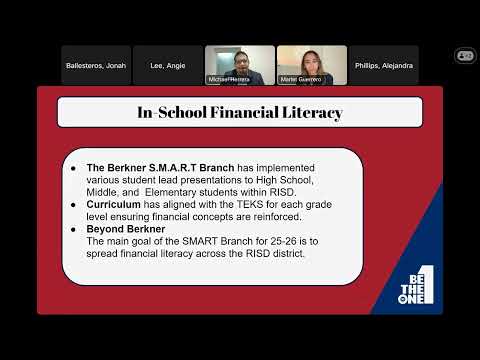
The Richardson ISD Parent University on May (date not specified) featured the Credit Union of Texas27s "smart branch" at Berkner High School and detailed how the program delivers hands-on financial education districtwide. Michael Herera, branch manager for the Credit Union of Texas at Berkner, said the program aims to give students practical experience and to build lifelong financial habits.
"The smart branch is so much more than just a bank. It's the center of hope for students," Herera said, describing a work-school partnership that places student interns in real teller and customer-service roles. He said the branch, which opened in fall 2023, serves all Richardson ISD students, staff and families, not only those at Berkner High School.
Why it matters: Herera framed the partnership as a local response to gaps in required K2012 instruction, saying that only 25 states require a semester of financial education to graduate and that Texas is not one of them. He also told participants that "Texas students have accumulated over $127 billion in student debt," presenting that statistic as part of the rationale for earlier, district-led instruction.
Program scope and reach: Presenters said the smart branch runs age-appropriate, student-led presentations across grade levels and has tested a third-grade curriculum this year. Herera reported that the branch reached 444 third-graders between February and April 2025 and expected roughly 243 more during a full week of May programming, which he said would bring the total to about 603 third-graders exposed to basic income-and-spending lessons.
Student voice and classroom approach: Student branch manager Marlette described activities used with children: gamified exercises, a simple tour of branch operations and interactive lessons to teach budgeting, saving and an introduction to credit. "I think our generation lacks a lot of financial literacy," Marlette said, urging parents to model good habits and to start small savings practices at home.
Products and incentives: Presenters reviewed account and incentive details available for Richardson ISD families through the credit union. They described a student savings account and a student checking account (checking accounts begin at age 12; savings accounts may be opened earlier with a Social Security number). A "save-the-change" option rounds debit purchases to the next dollar and deposits the difference into a savings account; presenters said once a member saves $240 the credit union will deposit $120 as a reward. The credit union also operates a "pay for grades" program (presenters said each A earns $25 and each B $5 per semester) and an annual $2,500 scholarship for members pursuing higher education.
Access and operations: The smart branch is open to the public during school hours for customer-service learning experiences, and the credit union said it provides a community engagement specialist assigned to Richardson ISD to coordinate events and school visits.
What presenters urged parents to do: Attend branch events, model budgeting at home, involve children in household-money conversations and consider branch visits as practical learning activities. Herera encouraged parents to contact school principals or the Berkner smart branch to schedule classroom visits or community events.
Notes on claims and figures: The session included numerical claims presented by speakers (for example, the 25-state requirement statement and the $127 billion student-debt figure). These figures were presented by presenters during the Parent University and were not verified on the record during the session; the article attributes those figures to presenters rather than treating them as independently confirmed.
The Parent University closed with contact information for the Berkner smart branch and a request that parents reach out for more information or to arrange programming.