Get Full Government Meeting Transcripts, Videos, & Alerts Forever!
Get email alerts on the Transportation topic
No spam. Unsubscribe anytime.
Woodside CAC backs modest safety fixes, asks consultants to refine downtown redesign options
Summary
After reviewing multiple street- and plaza-design concepts for Woodside town center, the Community Advisory Committee asked consultants to prepare a modest safety-focused "option zero" and a revised Option One that restores key parking and improves sight lines at the Kinyatta–Woodside–Mountain Home hub, while preserving larger plaza and shared‑street ideas for later study.
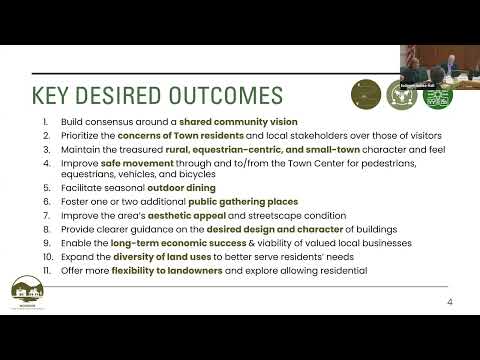
The Woodside Community Advisory Committee on Tuesday reviewed a series of conceptual designs intended to slow traffic and improve pedestrian, bicycle and equestrian access through the town center and asked staff to return to the council with two refined options.
Consultants from Good City Company and Alta presented five topic areas and three major alternatives for the complex Kinyatta–Mountain Home–Woodside intersection, plus block-by-block ideas for Woodside Road, shared-street concepts behind the commercial row, and shoulder and trail options toward I-280. After extended discussion and several quick shows of hands, the CAC coalesced around asking staff to prepare a modest “option zero” (targeted safety fixes that retain key traffic movements) and a modified Option One that restores 90-degree parking directly in front of Robert’s Grocery while shifting a crosswalk east to improve sight lines.
“We heard the group here is expressing support for a new option that we can create and bring to council,” said Troy, one of the consultants, characterizing the group’s direction to staff to produce two near-term alternatives along with other, larger redesigns to show council for consideration.
The safety-focused changes the committee prioritized include lane‑narrowing and traffic‑calming near the elementary school, clearer marked crossings (including raised crosswalks or speed tables), formalized bike lanes where right-of-way allows, and clearer, documented parking rules at the Little Store and Village Hub. Melissa Cardelli, the acting town manager, gave police-reported collision data for the corridor: she said the sheriff’s office provided ten reported incidents on Woodside/Kinyatta/Mountain Home between Jan. 1, 2024 and April 20, 2026, a statistic members cited in arguing for expedited safety fixes.
The committee’s discussion repeatedly balanced pedestrian safety and the town’s role as a regional route. Residents and CAC members emphasized that Woodside Road supports horses and trailers and is also a primary wildfire evacuation route, arguing that any narrowing or traffic shifts must maintain emergency capacity. Several members urged caution about speed‑bumps and lane reductions because of horse trailers and heavy weekend traffic.
The Robert’s Grocery parcel emerged as a flashpoint. Consultants’ concepts included a range of public‑space options— from a small plaza set off the street to a larger 6,000‑square‑foot park created by rerouting a slip lane. Christine Roberts, the store owner, told the committee she was surprised and alarmed to see proposals that would move parking away from her storefront.
“I had no idea that the idea was to take away parking from my business,” Roberts said, urging the town to work directly with her before moving forward on any plan that would reduce market parking. Her attorney, Lee Prince, likewise recommended pausing any concept that affects the shop’s operational parking until the town and Roberts have clarified property lines, right‑of‑way and how parking would be enforced.
Consultants said they would incorporate the committee’s direction: prepare an option that minimizes changes while improving safety, and a second, revised concept that restores the market’s parking while improving pedestrian sight lines. Those two concepts will be shown to the Town Council at its next meeting; the consultants said they would keep the larger plaza and shared‑street ideas alive as alternate scenarios for future refinement.
Next steps: the consultant team will refine the two requested options and present them to council; the CAC expects follow-up meetings, a public survey and further community engagement before any environmental review or construction occurs.