Get Full Government Meeting Transcripts, Videos, & Alerts Forever!
Get email alerts on the Treatment And Recovery Center topic
No spam. Unsubscribe anytime.
Douglas County reviews TRC interim memo as KDADS licensing caps capacity below building design
Summary
Consultants told Douglas County commissioners that KDADS licensing limits the Treatment and Recovery Center (TRC) to 16 people even though the facility was built for 32; the interim memo flags capacity, data alignment, staffing and reimbursement as priorities and asks for follow-up financial detail before a May funding decision.
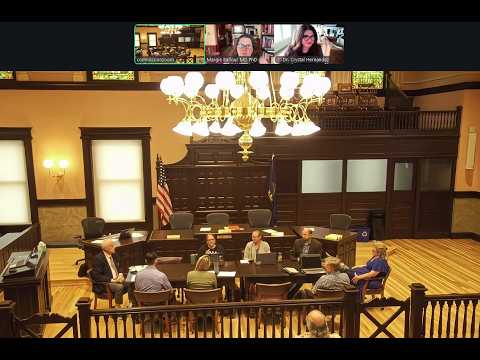
A panel of county staff and outside consultants on April 22 told the Douglas County Board of County Commissioners that the Treatment and Recovery Center (TRC) is valued by the community but faces operational and financial challenges that must be resolved before the county considers additional funding.
Dr. Margie Balffor, one of two Multipass Consultants who conducted phase one of the TRC review, said the interim memo — to be followed by a final report in May — identified recurring themes: strong community support for the TRC, capacity and throughput problems, inconsistent data reporting across agencies, and the need for clarified medical-clearance criteria between EMS, emergency departments and the TRC. "The community really values the TRC," Balffor said, and consultants have focused on operational issues and tools for managing high census and medical-clearance criteria.
County staff and consultants told commissioners that Kansas Department for Aging and Disability Services (KDADS) clarified licensing and confirmed a limit of 16 people for the admissions/observation/stabilization functions under current regulations. "We built a facility that could accommodate 32 people," said a county staff member, "but KDADS regulations limit the capacity of the building to 16," a mismatch the consultants said has affected the original financial model and revenue expectations.
Consultants also urged better alignment on metrics and data definitions. Balffor said EMS, the TRC and hospital emergency departments currently measure transfers and admissions in different ways, making it hard to track flows or automate reporting. County staff said IT work to create PowerBI visualizations and dashboards is under way to help synthesize three years of baseline data.
Staff and consultants discussed staffing, training and safety. Ryan Storch, crisis services senior director at Bert Nash, described a 3–4-day intensive crisis de‑escalation training used at the TRC, additional safety measures such as extra security posts and wearable communications devices, and ongoing efforts to recruit and retain staff. Storch noted competition for workers in the market — including large employers raising starting wages — and said mentorship and a dedicated medical director are priorities.
On utilization, consultants and staff reported roughly 1,200–1,300 unique individuals and about 3,500 visits annually; approximately 1,500 of those visits resulted in admission to observation or stabilization units. County staff said a "familiar faces" cohort of about 14 people cycles through the system regularly. They also reported that after the capacity cap went into effect there were roughly 18% fewer admissions into observation/stabilization compared with the prior year, a change the group said requires further analysis.
Financial questions remain central. Dr. Crystal Hernandez, lead on the financial analysis, said the TRC's historical budget had been blended and consultants are separating costs into three buckets to produce a clearer cost picture for Prospective Payment System (PPS) reimbursement and county budgeting. Consultants said they have submitted a required cost report to the state and are working through revenue-cycle and EMR issues to understand backlog claims and sustainable reimbursement. Staff said some financial detail can be provided before a May 20 presentation on a 2026 funding request, but the final consultant report may not be complete by that date.
Several commissioners asked about the scope of the consultants' interviews. Balffor said the review included ED staff, law enforcement, EMS, substance-use providers, peer groups and TRC leadership, but that frontline staff participation was limited by project scope and ongoing union negotiations. Balffor and Dr. Hernandez said follow-up interviews with financial consultants, TRC and Bert Nash leadership and county data staff are planned to close remaining gaps.
The work session produced no formal votes. Commissioners thanked staff and consultants and recessed the work session until the 5:30 p.m. business meeting. The consultants said they will deliver a final report in May that will include specific recommendations, a proposed cooperative alignment agreement and suggested next steps for staffing, data and regulatory engagement with KDADS.