Get Full Government Meeting Transcripts, Videos, & Alerts Forever!
Get email alerts on the Construction Projects topic
No spam. Unsubscribe anytime.
Mesa council questions CMAR selection and pre‑construction terms for 911 communications center
Summary
Council members asked staff for details about how Willmeng was chosen as the Construction Manager at Risk (CMAR) for the new 911 communications building and how the contract price and CMAR fee will be set; staff said the contractor was solicited in October 2025, the authorized bond was $54 million and the CMAR fee typically ranges about 0.75%–1% of construction cost, with a GMP to be negotiated later.
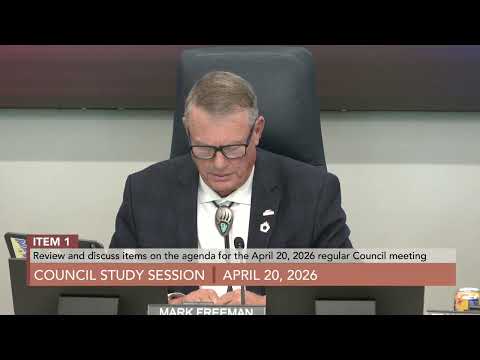
Mesa council members pressed staff at a study session April 20 about the city’s selection of Willmeng as the Construction Manager at Risk for a planned 911 communications center and how the contractor’s pre‑construction and guaranteed maximum price (GMP) will be set.
Council Member Goforth asked staff to explain “the CMAR process, how we chose Willmeng and determined the contract price,” and a staff member identified as Lance described the procurement: the solicitation went out in October 2025, evaluators awarded points for experience, understanding of the project, workload and whether a firm is local to Mesa, and a panel shortlisted firms, interviewed finalists and then made a final selection. “We solicited back in uh October of ’25,” Lance said, and the city “shortlist[ed] that to a group that we interview with, and then in that case, uh we’ll go through interviews and then make a final selection.”
On price, Lance said the city issues a request for qualifications with a general range tied to the bond authorization but does not set a fixed construction dollar amount until a GMP is negotiated: “we never fully defined until we identify a GMP, a guaranteed maximum price.” He added the CMAR pre‑construction fee is a small portion of total construction cost and typically “ranges anywhere between maybe 3/4 of a percent to a a percent of the overall construction cost.” The pre‑construction contract pays for services that lead up to the GMP; the city will return to council with the GMP for approval.
Staff told council the project is in design and expected to be roughly a year or a little more from construction start, but schedule risks exist because of site coordination with the adjacent Fire Station 223. Lance said Willmeng was also the contractor selected for the fire station and that “when you have one contractor and these two projects, it’s actually really helpful” for efficiencies and potential shared infrastructure savings.
The city confirmed the authorized bond amount for the communications project is $54 million. Council was told the pre‑construction agreement could cover a variable timeframe—“it could take 6 months or it could take 2 years”—because the contract procures services until the GMP is achieved.
What’s next: staff will continue design and pre‑construction work with the selected CMAR, negotiate the GMP, and bring that guaranteed maximum price back to council for formal consideration.