Get Full Government Meeting Transcripts, Videos, & Alerts Forever!
Get email alerts on the Education Rightsizing topic
No spam. Unsubscribe anytime.
Portland superintendent frames ‘right‑sizing’ plan as enrollment, budget and aging buildings push change
Summary
Portland Public Schools leaders told a packed community session at IDB Wells that sustained enrollment declines, a budget shortfall and aging facilities have prompted a districtwide “right‑sizing” effort. District staff said they will present a recommendation to the board in November and asked families to prioritize guiding principles through polling and written feedback.
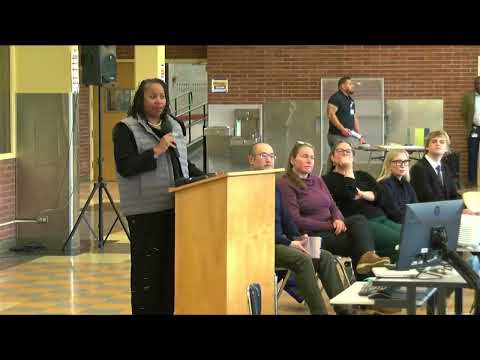
Dr. Kimberly Armstrong, superintendent of Portland Public Schools, opened a community engagement session at IDB Wells by telling families the district is launching a “right‑sizing” process driven by three facts: falling enrollment, a persistent budget gap and aging school buildings.
"We have fewer students enrolled," Armstrong said, and the district is seeking community input to develop guiding principles that will shape options staff present to the school board. She emphasized the session was for listening: the district has not yet made closure or boundary decisions.
Why the effort
District presenters repeatedly pointed to long‑term enrollment decline as a root cause. Board member Christy Split told the room, "we have 12,000 fewer students," framing right‑sizing as a response to that multi‑year trend. Dana Styles, director of early learners, said the district’s analysis shows "the primary driver right now for declining enrollment is actually lower birth rates," with additional local capture‑rate effects.
Staff also described a growing budget shortfall and aging facilities. The superintendent said many PPS buildings are over 80 years old and that some sites present maintenance and seismic vulnerabilities that need attention alongside program and staffing considerations.
Process, data and timelines
Richard Smith, senior director for research, assessment and accountability, laid out the data work: enrollment projections, capture‑rate analysis, programmatic inventories and modeling. He urged attendees to complete an interactive Slido poll and said researchers will compile session memos to inform the board.
On timing, staff told an audience questioner that the superintendent intends to present a recommendation of possible actions to the board in November; any closures or consolidations would not take effect until the start of a later school year, after board action and additional community processes.
What officials say is in scope
District leaders said they are exploring a range of options—boundary changes, consolidations and program moves as well as closures—and stressed that right‑sizing is intended to help the district equitably direct limited resources so every school can be well‑resourced. Margaret Calbert, assistant superintendent of school planning and modernization, said the process will consider both districtwide portfolio tradeoffs and localized community impacts.
Community concerns and program demand
Many parents described strong demand for specialized programs that have high application rates. Multiple commenters said programs such as Winter Haven and Access Academy attract more applicants than seats and that unmet demand has driven some families to leave PPS. Parents and board members urged the district to identify which successful program features—project‑based learning, smaller cohorts, staff continuity—could be replicated to retain families across neighborhoods.
Property, budget and benefits questions
Attendees asked what would happen to closed properties; staff said the district maintains some vacant sites, leases others, and that when sites are sold other government agencies have first right of refusal before open market sales. On finances, staff noted PPS must maintain minimum reserves for bond ratings and that large benefit and retirement costs are a material portion of personnel expense; the district will publish more detailed cost information at upcoming budget presentations.
Next steps
The district will continue community engagements (scheduled sessions at Benson and Roosevelt were announced), publish answers to submitted questions, release research memos summarizing engagement inputs, and present options to the school board in the fall. The superintendent and board encouraged families to attend a May 7 school‑funding forum with state lawmakers to press for increased K‑12 funding.
The district emphasized that no final decisions have been made and asked community members to submit priorities via the posted QR codes and Slido so staff can incorporate those preferences into the guiding principles that will shape possible proposals to the board.