Get Full Government Meeting Transcripts, Videos, & Alerts Forever!
Get email alerts on the Data Centers topic
No spam. Unsubscribe anytime.
Panel debates data centers’ jobs and environmental costs as communities press for transparency
Summary
At a Columbus Metropolitan Club forum, city officials, researchers and industry representatives weighed economic benefits from data centers against concerns over energy, water, land use and limited transparency, highlighting House Bill 15 and local moratoria as flashpoints.
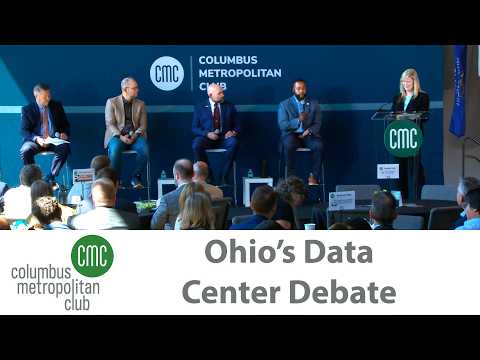
Columbus Metropolitan Club hosted a public forum titled “Ohio’s data center debate” at the National Veterans Memorial and Museum, where city officials, researchers and technology industry representatives weighed the local economic benefits of data‑center investment against rising concerns about energy, water, land use and transparency.
Columbus City Council member Christopher Wyche, who chairs the council’s public utilities and sustainability committee, said data centers bring real payroll benefits but that many residents “haven’t been seeing” broader community gains and asked how companies could deepen local benefits while protecting water and air quality. “After this data center has been built, I have worked in and out of this building for the last 10 years,” Wyche quoted a union worker as saying to underline job ties to the industry.
Why it matters: Central Ohio has emerged as a major hub—panelists cited an industry map showing 202 data centers in Ohio and 114 in Central Ohio—creating pressure on land, local utilities and municipal services. Panelists agreed that the debate matters to residents because of potential local air and water impacts, questions about tax incentives and the pace at which large infrastructure projects are approved.
Speakers outlined competing explanations for recent rises in electricity costs and for how the grid must respond if more large data centers locate in the region. Dr. Jeff Boleky, associate faculty director of research at The Ohio State University Sustainability Institute, and industry and manufacturing representatives criticized investor‑owned utilities’ long‑range load forecasts, saying speculative interconnection bids can create “phantom loads” that raise transmission and generation price signals regardless of whether the full forecasts materialize. “Follow the money,” said Ryan Augsburger, president of the Ohio Manufacturers Association, arguing that some cost increases reflect utility and generator incentives rather than data‑center demand alone.
Industry representatives said companies are taking steps to build new generation and buy renewable power. Tim Chadwick, Google’s area operations manager for Ohio, said Google has contracted a power purchase agreement for “1.5 terawatt hours of power from a solar facility that’s being built in northwest Ohio specifically to power our data centers,” and defended corporate procurement practices intended to avoid raising local rates. Chadwick also described onsite planning choices such as air‑cooled options when local water or sewer capacity is constrained.
Panelists described a growing trend of on‑site, behind‑the‑meter generation—sometimes natural gas‑fired turbines—because of the long lead times for transmission and new generation (panelists cited typical timelines of roughly 18–24 months to build a data center versus 5–10 years for new transmission or generation). Dr. Boleky noted that some large projects are installing their own combustion turbines to ensure reliability, but added that such onsite generation shifts emissions and water‑cooling burdens to local communities.
Water and local conservation concerns surfaced repeatedly. Panelists and audience members discussed industry estimates that some data centers can use “1 to 5 million gallons of water a day,” though industry representatives emphasized site‑specific planning and that in Ohio treated wastewater from data centers typically goes to municipal sewer systems. Marsha Miller, a resident negotiating Darby Accord land protections, said she was “desperately concerned” about a proposed data center near 1,300 conserved acres of wetland and prairie and asked how siting decisions could protect sensitive waterways and habitat.
Transparency and local control were recurring themes. Audience members and Columbus City Council member Wyche criticized the use of nondisclosure agreements and proprietary claims that limit municipal review of projected water and emissions impacts. Wyche said local governments that supply municipal water can require disclosure as a condition of service, and panelists urged clearer forecasting and public engagement so communities can evaluate tradeoffs before projects proceed.
Policy and next steps: The forum highlighted several pending legislative and regulatory issues. Speakers referenced House Bill 15—described by an audience questioner as allowing data centers to fast‑track behind‑the‑meter gas plants without local consultation—and several bills under study in the Ohio General Assembly. Panelists urged improved transparency in utility forecasting and said legislative study commissions should move quickly to avoid decisions being made before protections are adopted.
What remains unresolved: Panelists disagreed over how much current rate increases can be attributed to data‑center demand versus utility forecasting and market incentives. Several audience members urged tighter local land‑use rules or moratoria in sensitive areas; panelists said local officials must weigh economic benefits against conservation and community impacts.
The forum closed with a call for more public engagement and research. Panelists and the moderator urged attendees to contact elected officials and follow ongoing legislative discussions; no formal votes or city actions were taken at the event.