Get Full Government Meeting Transcripts, Videos, & Alerts Forever!
Get email alerts on the Acquisition Inrem topic
No spam. Unsubscribe anytime.
DHCD details ramped in-rem filings, seeks faster title, appraisal and disposition workflows
Summary
DHCD officials told the council they have stepped up in-rem filings (about 1,191 to date) and are reorganizing staff and vendor contracts to speed acquisitions, condemnations and dispositions while asking for more transparency about the pre-filing pipeline.
The Baltimore Department of Housing & Community Development on Tuesday told the City Council's Housing & Economic Development Committee it is increasing in-rem foreclosure activity and reorganizing teams to move more vacant properties from filing to disposition.
"I started in DHCD as acting commissioner in March," Acting Commissioner Tim Keane said, introducing staff and the department's acquisition agenda. Joe Kersner, assistant commissioner for the development division's legal section, told the committee the department had filed about "1,175 cases" and that number had risen to "1,191 at this point," with roughly 836 judgments entered and an average filing-to-judgment time that has fallen toward about 161 days.
Why it matters: The department's ability to acquire—and then reliably convey or rehabilitate—vacant buildings underpins the city's broader vacant-property strategy. Council members pressed DHCD for better pipeline transparency and clearer timelines so community partners know when a property will reach disposition.
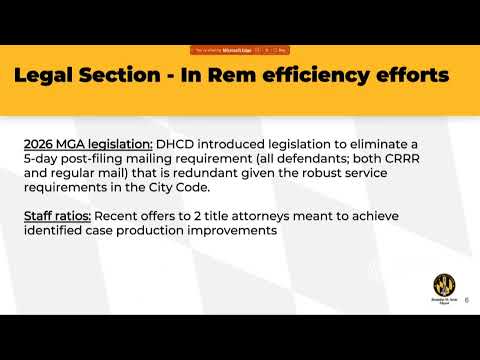
Kersner said DHCD is balancing staff ratios (aiming for a roughly 2:1 ratio of filing attorneys to title attorneys), expanding paralegal and title capacity, and contracting for appraisals and abstracts to speed work. He described a cooperative contract on the Board of Estimates agenda to bring on appraisers and abstractors, noting the cooperative contract value for appraisers is $225,000 each.
Land-management staff explained a plan to set up a dedicated dispositions team and cross-train personnel so acquisitions and disposition workloads can shift as demand changes. The department also described testing efficiencies such as reducing redundant mailings and investigating whether two appraisals per property are a written requirement or past practice.
Council members from multiple districts raised operational questions that could affect priorities and sequencing. Vice Chair Odette Ramos asked that DHCD revise the district heat maps to reflect acquisitions completed earlier in the program; Councilman Germaine Jones pressed DHCD to quantify how long a case spends in pre-filing preparation versus the formal filing process (staff estimated a target of roughly four to five months from identification to filing once title work is ordered, but said historical cases can take longer); and Councilman Zach Blanchard asked how dispositions reach developers once properties are acquired.
DHCD acknowledged the court system is a chokepoint: "If we keep adding to the front end we will just have a backlog of stuff eventually," Deputy Mayor Calvin Young said, urging a systemwide approach that includes court capacity and continued tracking of staffing needs.
The committee did not vote on a policy change; members requested more granular pipeline data and additional detail about contracts, staffing hires and district-level maps.