Get Full Government Meeting Transcripts, Videos, & Alerts Forever!
Get email alerts on the Budget Fy27 topic
No spam. Unsubscribe anytime.
Methuen school leaders outline hard choices as FY27 budget faces $8M-plus gap
Summary
At a budget workshop April 22, Methuen School Committee members were told level-service costs rose to roughly $123M while the likely school allocation was near $114M, leaving an $8—$10 million shortfall; the committee discussed one-time solutions, structural reforms, and procurement moves for bus-stop enforcement and solar projects.
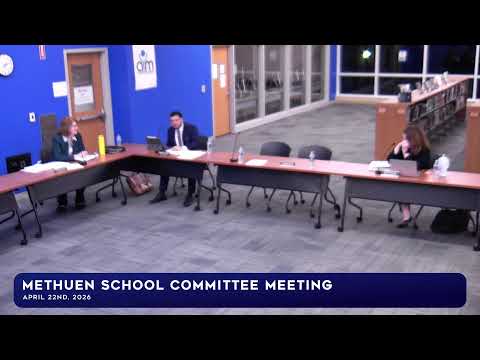
Methuen, Mass. — At a budget workshop on April 22, the Methuen School Committee heard administration and city leaders describe a large gap between the district's level-service budget and the funds likely to be available for fiscal 2027, prompting discussion of one-time fixes, program priorities and longer-term structural reforms.
Superintendent Dr. Golabski told members the district's level-service budget rose from about $110.6 million last year to roughly $123 million this year, a jump the administration said cannot be funded within the city's present tax limits under Proposition 2—2. The mayor and members said an override is not politically viable in Methuen; instead, officials are examining a mix of one-time uses of free cash, targeted cuts, and options such as early retirement incentives and procurement savings.
"We're dealing with an extremely difficult budget cycle," the superintendent said, framing the discussion with a request that members help identify priorities to protect as staff and programs are trimmed. Member Keegan summarized the scale of the challenge: "We're about 8 and a half million dollars difference from the money that we are given and the level services that we have," she said, urging the committee to create an ordered list of restorations should state aid arrive later.
Members stressed two parallel strategies: press state lawmakers for more aid and reshape local spending. Several members urged advocacy for state amendments—most notably a proposed increase in the circuit breaker special-education reimbursement to 90 percent—which administration staff estimated could yield roughly $1.8—$1.9 million for the district if enacted and passed down to Methuen.
Administration offered examples of one-time items that could be covered from non-recurring funds, including five students aging out of out-of-district placements whose combined outlays total $618,478.27. Officials said free cash (the city's rainy-day fund) exceeds $20 million, but they cautioned it is not a sustainable source for recurring costs.
Committee members pressed the administration on specific program and personnel requests that surfaced in the district's a la carte budget, including half-time clerical positions for student services and bilingual parent-liaison roles. Assistant Superintendent Bozak told the committee she would present an updated plan for special-education cost containment, including a prior proposal to reduce out-of-district placements.
Transportation and procurement also figured prominently. The mayor and members reported procurement work is underway to allow competitive bids for a school bus stop-arm enforcement program (the local option adopted by the legislature), after the Inspector General advised against a sole-source contract. "The bid specs are in the works with the first assistant city solicitor," administration said, and going out to bid would protect the municipality from a sole-source procurement risk.
Officials also said solar projects are moving through procurement and emphasized the need to identify vendors and projects before anticipated July changes in federal tax incentives. "We need to have that vendor relationship established and projects identified before that deadline," a member said.
Longer-term revenue ideas discussed included a virtual academy to sell seats to out-of-district students and expanding school choice; members estimated school-choice revenue could recoup significant amounts over time but noted those options would not close this year's gap.
On cost-control initiatives, some members urged the district and municipal partners to explore joining the Group Insurance Commission (GIC) and other structural reforms to achieve recurring savings on health insurance and benefits, but administration said any decision on health insurance options must proceed in partnership with employee bargaining units and the municipal committee handling benefits.
The committee did not take formal votes on program cuts or staffing at the workshop. Two routine procedural motions to accept the agenda and to adjourn were approved by roll call. The administration said it would return with refined numbers and a prioritized list of recommendations as it continues daily budget reduction work in the run-up to the city council's budget process in early May.
What happens next
Members asked the administration to return with a tightened budget that shows where reductions would be made, plus an ordered restoration list if state aid materializes. The superintendent and finance staff said they would continue to identify one-time opportunities and structural reforms and present an updated packet at the committee's next meeting for formal action.