Get Full Government Meeting Transcripts, Videos, & Alerts Forever!
Get email alerts on the Affordable Housing topic
No spam. Unsubscribe anytime.
Burbank Housing Corp. asks council for conditional financing to build 60-unit Village at Fairview, proposes repurposing activity centers
Summary
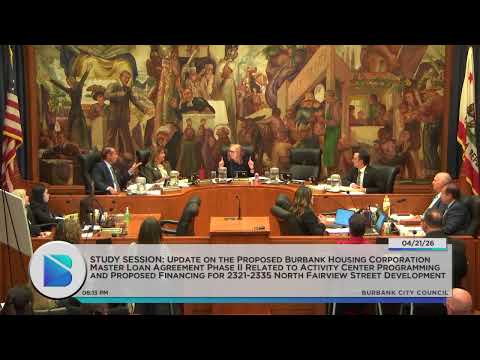
At an April 21, 2026 joint study session the Burbank Housing Corporation sought conditional commitment letters and permission to repurpose activity-center space to support the Village at Fairview, a proposed 60-unit affordable housing development; presenters said the move would stabilize BHC finances and enable new units but no formal vote was taken.
At a joint study session of the Burbank City Council and the Housing Authority on April 21, 2026, the Burbank Housing Corporation (BHC) asked the city for conditional commitment letters and permission to change the use of several activity-center sites so it can redevelop four contiguous parcels on Fairview Street into the Village at Fairview, a 60-unit affordable housing project.
BHC Executive Director Sylvia Moreno told the council the project is part of MLA (Master Loan Agreement) Phase Two and is intended to stabilize the organization’s finances while expanding affordable housing supply. "For more than 25 years, this partnership has stabilized neighborhoods and created lasting affordable help opportunities for our Burbank residents," Moreno said, and she introduced a development team that includes RSG Consulting, Homes in Hope and Y&M Architects.
Why it matters: BHC said its after-school activity-center program has experienced declining participation and high operating costs. Dina Fuentes of RSG Consulting presented a portfolio analysis showing that keeping the activity centers in the portfolio produced a cumulative loss of more than $1.8 million, while transitioning away from the centers would shift the same portfolio to "a positive 10-year cumulative cash flow of over $400,000," she said. Fuentes framed the change as a move to preserve BHC's real-estate assets and create more housing.
Project details and financing: Presenters described the Village at Fairview as a four-story, 60-unit development on parcels zoned R4 in the Golden State neighborhood. The plan includes 20 project-based vouchers (15 designated for permanent supportive housing for homeless families with children, and five for lower-income families). Architect Manuel Salas described a central courtyard, recreation room, tot lot and one level of subterranean parking with about one stall per unit.
Alex Russell of Homes in Hope summarized the schedule and budget: the total project cost is about $49.8 million, the largest single financing source would be tax-credit equity (roughly $29 million), the team plans to borrow about $4 million in permanent debt, is requesting about $8.4 million in new city funding, and plans to roll over $2.9 million in existing property debt. The presenters said the city's contribution would leverage nearly $40 million in state and federal funding. "This project is about $49.8 million," Russell told the council.
Tenant protections and services: BHC said TranSystems prepared a tenant-relocation plan and Home Again LA will serve as the supportive-services provider with an on-site office. Relocation consultant Sonia Sherlock explained households on the impacted sites will have right of first refusal to return; if households decline to return they may opt for permanent relocation assistance (moving costs and rental assistance), which Sherlock said would be calculated for 42 months, or use relocation assistance toward home purchase if they qualify. "They actually can choose permanent relocation, which means that they get relocation assistance ... for 42 months," Sherlock said.
Activity-center transition and Bridge program: BHC proposed transitioning legacy after‑school participants to a Bridge program run in partnership with the Boys & Girls Club at 14 BUSD campuses, budgeting $18,000 for the initial fall semester to reduce fees for BHC families. BHC also proposed converting three of four activity-center sites into housing and converting one site to a property-management office; renovation funding would come from developer fees and capital replacement reserves.
Questions from council members focused on relocation details, funding source restrictions and construction costs. Staff clarified the city funding being requested would come from restricted housing sources — federal HOME funds and the low- and moderate-income housing asset fund (former redevelopment agency funds) — and would not use unrestricted general-fund dollars. Construction and cost details cited by the team included an estimated cost of about $352 per square foot (over ~85,000 sq. ft.) and a 5% hard-cost contingency plus internal contingencies.
Next steps: The presentation was informational; BHC requested conditional commitment/reservation letters and asked staff to return next month with the proposed loan documents and finalized financing when other financing has been secured. No formal council vote or loan approval occurred at the study session.
Funding and timeline highlights: the TCAC/LIHTC application is due May 19, 2026; awards (if successful) are anticipated Aug. 18, 2026; council consideration of loan documents and the relocation plan is expected in September 2026; construction would begin in March 2027 if timing holds, with an estimated 21-month build and occupancy in December 2028.
The study session closed without action; staff will return with final documents for formal consideration.