Get Full Government Meeting Transcripts, Videos, & Alerts Forever!
Get email alerts on the Music Program topic
No spam. Unsubscribe anytime.
Parents, students urge Mukwonago board to preserve elementary band and orchestra; board tables decision
Summary
Dozens of students, parents and teachers told the Mukwonago Area School Board that proposed changes to elementary band and orchestra would erode music education; after lengthy debate and failed roll-call votes on two proposals, the board voted to table the music-program decision until May.
Dozens of students, parents and teachers urged the Mukwonago Area School Board on a motion-packed night to preserve elementary band and orchestra amid proposed schedule and instructional changes tied to district budget planning.
Student Marlena Warner told the board, "Cutting band and orchestra is not a solution to the money problems," and several parents and music educators followed with detailed testimony about participation, teacher staffing and pipeline effects between elementary and secondary programs.
The speakers framed their appeal around two linked points: participation and transparency. Parent and educator Lisa Warner said the district had steadily reduced staffing over the years and asked the board to "look beyond two or three districts" for alternatives to cuts. Community organizer Steph Merkel described grassroots activity — a Facebook group, more than 800 petition signatures and rallies — and urged the board to engage the community "early and often." Josh Warner pressed the board for fiscal clarity, asking repeatedly whether either proposal showed how music would contribute to the district's stated $750,000 reduction goal: "If this vote does not fix the budget, what exactly are we changing?"
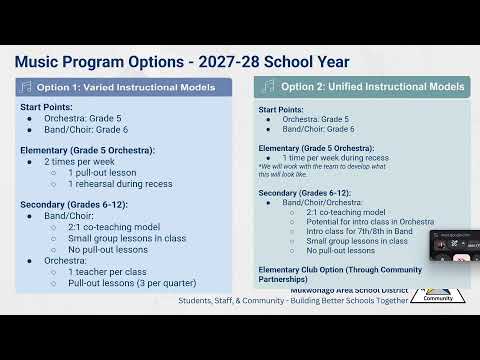
Administration described the scope and constraints that shaped its proposals. District presenters said the music program currently uses roughly $1.5 million in staffing and related investment and emphasized three parameters for any change: maintain program quality, remain FTE-neutral (about 15.75 positions), and reduce routine pull-out instruction at the secondary level. The administration presented two options: one that retains limited elementary pull-outs and preserves established entry points (orchestra at fourth/fifth grade and band at fifth/sixth, phased across years), and a second that eliminates pull-outs by shifting more small-group instruction into co-taught class time and a single elementary touch point per week. Officials also proposed exploring community-club partnerships to supplement elementary instruction.
Board members debated the educational trade-offs and staffing math across several motions and roll-call votes. A proposed amendment to add an elementary club component to option one passed initially, but a later roll-call vote to approve option one with that amendment failed (the roll-call recorded Yes votes from Jason, Jake and Craig; No votes from Crosby, Mike, Jim, Dale, Eric and Carolyn). A subsequent roll call on option two likewise failed (Yes: Mike, Dale, Carolyn, Craig; No: Jason, Crosby, Jake, Jim, Eric). After those results, the board approved a motion to table the final music-program decision until the May meeting to allow more time for analysis and community engagement.
Community members said the pause was welcome but not sufficient. Several asked the board to require district staff to show the precise fiscal contribution of the music proposals to the $750,000 target and to share the staffing and schedule models used to forecast instructional impacts. Administration committed to continuing conversations with teachers and community partners and to report back with additional modeling.
Next steps: The board will revisit the music-program proposals at its May meeting; the administration said it would bring refined scheduling models, participation metrics and any community-partnership plans developed in the interim.