Get Full Government Meeting Transcripts, Videos, & Alerts Forever!
Get email alerts on the Taxes topic
No spam. Unsubscribe anytime.
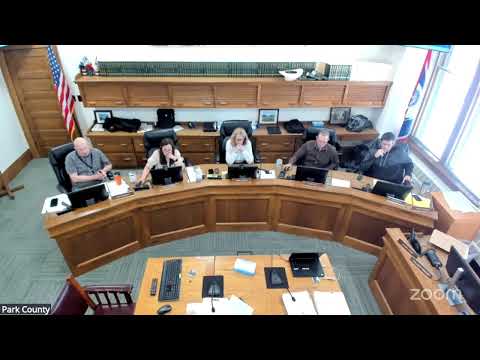
Park County commissioners approve placing Cody Conservation District one-mill tax question on primary ballot
Summary
The Park County Commissioners voted to place a measure asking voters to authorize a conservation-district tax not to exceed one mill for the Cody Conservation District on the primary ballot. The district seeks a permanent, rescindable levy to provide stable funding and expects the average property owner to pay roughly $30'$40 annually per mill.
The Park County Commissioners on voice vote approved placing a question on the upcoming primary ballot asking voters whether to impose a conservation-district tax "not to exceed one mill" within the Cody Conservation District.
Richard Jones, a supervisor with the Cody Conservation District, told commissioners the district is one of only two in the state without a permanent funding source and is seeking stability to plan multi-year natural resources programs. Jones introduced John Tanaka, the district chair, and Corey Williams, the district manager, and said the board prefers a permanent, rescindable mill rather than a short-term renewal.
County staff read the standard statutory language for the proposition and explained the two statutory approaches: a four-year renewable proposition or a permanent levy that remains until voters approve discontinuation by petition and subsequent ballot measure. Park County First Deputy Hans summarized the rescission process and cited the relevant statutory option the district requested.
Commissioners pressed the district on public outreach, ballot wording and cost. Jones estimated that one mill would have amounted to roughly $30'$40 per year for an average property in the district based on previous valuations, and stressed the need for targeted education to help rural voters understand the conservation district's role.
Elections staff advised that placing the nonpartisan question on the primary ballot will add an unaffiliated ballot style in rural precincts (about 309 unaffiliated rural voters) and estimated a small additional administrative cost (roughly $300'$500).
A commissioner moved and seconded the request to place the district's chosen Romanet 2 (permanent-but-rescindable) wording on the primary ballot; the board approved the motion by voice vote.
Next steps: county staff will work with the district to finalize the exact ballot language and arrange for the question to appear on the primary ballot as approved. The district said it plans voter education and may pursue a future special election if voters do not approve the measure.