Get Full Government Meeting Transcripts, Videos, & Alerts Forever!
Get email alerts on the Surveillance Policy topic
No spam. Unsubscribe anytime.
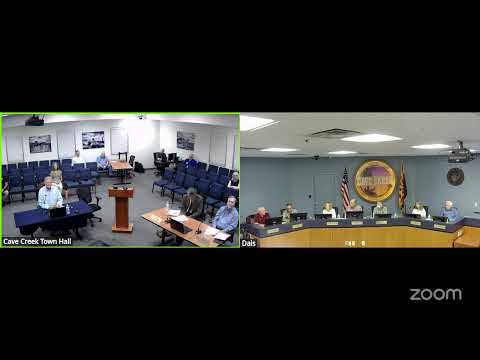
Cave Creek council unanimously directs staff to draft a policy for license‑plate readers after privacy concerns
Summary
After resident concerns about data retention and access, the council directed staff to draft a local policy modeled on Safford’s LPR policy; town attorney and the marshal described contract safeguards, use cases and auditing controls.
The Cave Creek Town Council voted unanimously to direct staff to prepare a policy governing the town’s license‑plate‑reader (LPR) cameras and their use after residents raised privacy and data‑security concerns.
At a council retreat earlier this year members asked staff to return with more detail about the town’s Flock camera contract, including where data are stored and who has access. Town attorney Bill reviewed the vendor contract and recommended the council consider adopting a policy modeled on a Safford Police Department policy to add explicit safeguards.
Bill summarized the contract and the policy rationale: “They have to strip it from anything that allows the individual to be identified,” he said, describing how stored images are processed under the agreement and how a local policy could add access restrictions, retention limits and audit procedures.
Bill and Marshall Stein described examples where the LPR system aided investigations: detection of a homicide suspect passing through a jurisdiction, locating a suspect who had left the area in a child‑sex assault case, recovering missing people (silver alerts), and identifying vehicles in a hit‑and‑run. Marshall Stein said Cave Creek has used the system to help identify suspect vehicles and recover stolen property and that only one sworn town officer currently has access to the system.
Residents and councilmembers questioned data security and whether Flock had ever been hacked. Bill said Flock has denied being hacked and that contractual terms prohibit selling town data; he also offered to bring back details on audit controls used in Safford. Councilmembers requested information on the number and locations of cameras, whether temporary cameras are used for events, retention time (contract vs local policy), and whether data are kept off‑site.
A motion to direct staff to prepare a draft policy — to include camera counts, storage/retention details, signage and whether temporary placements are used — passed 7–0. Councilmembers asked staff to solicit Safford’s audit documentation, consult the sheriff’s office for endorsements and provide the information to the public and on the town’s website.
Council did not change operational access to the system at the meeting; the motion directed staff to return with a proposed policy and additional technical and legal details.