Get Full Government Meeting Transcripts, Videos, & Alerts Forever!
Get email alerts on the Parks And Open Space topic
No spam. Unsubscribe anytime.
New Canaan panel approves Waven Park restoration plan to remove Norway maples and replant natives
Summary
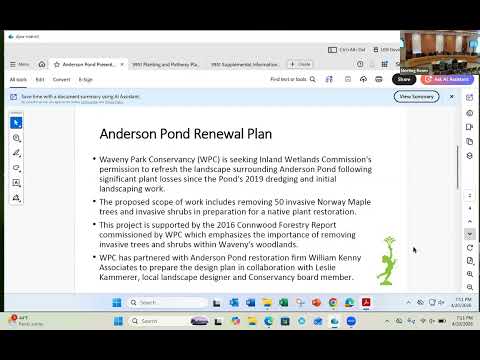
The Inland Wetlands Commission unanimously approved a permit for a Waven Park project that will remove roughly 50 Norway maple trees near Anderson Pond, install defined permeable paths and stepping stones, and replant a staged native palette; the approval includes special conditions on methods, debris removal and licensed herbicide use.
The New Canaan Inland Wetlands Commission on April 20 unanimously approved a permit for a Waven Park restoration project that will remove approximately 50 Norway maple trees and other invasive shrubs around Anderson Pond and replace them with a multi‑layer native planting plan.
The public hearing centered on application IW25‑53, presented by the Waven Park Conservancy and its consultants. The applicants described the work as targeted removals adjacent to the pond and upland review areas, followed by phased plantings in late spring and fall. The team said plantings will prioritize native understory, pollinator plants and deer‑resistant species, and that most planting work will be done by hand.
Why the removals: project designers argued Norway maples are suppressing native understory species and preventing natural regeneration. The conservancy’s landscape designer, Leslie Cameron, said the maples “leaf out earlier and stay leaf later” and therefore outcompete native plants, reducing habitat value. The applicants recommended removing maples near the wetland edge to open the canopy and allow a diverse native understory to establish.
Scope and planting plan: applicants presented a detailed zoning plan keyed to soil moisture and light, and a long plant list they said totals roughly 4,445 specimens across phases (10 canopy/flowering trees and more than 100 shrubs within the immediate pond area, with the bulk of work staged to test survivability before wider plantings). The team described three defined stepping‑stone access points and permeable paths intended to concentrate foot traffic and protect newly established beds.
Removal methods and oversight: applicants said tree work will be accomplished by hand or climbing methods in wetlands, with flush cuts only and no stump grubbing. Wood debris will be chipped and removed from regulated areas; no chipping or stockpiling within 50 feet of wetlands will be allowed. The contractor named in the presentation was Almstead Tree Care, a regularly used local firm. The wetlands agent proposed and the applicants accepted permit conditions requiring tree tagging by the tree warden prior to removal, inspection by town staff after completion, and removal of all debris off site.
Herbicide and regrowth control: Commissioners pressed the team on regrowth control. The applicants said the recommended approach for any stump treatment is a limited, hand‑applied herbicide (contractor‑applied glyphosate/triclopyr mixes were mentioned as an example), performed only by licensed applicators, with signage to inform the public. Commissioner Sanford said she prefers non‑chemical approaches but acknowledged license and isolation procedures; the wetlands agent confirmed state law requires licensed pesticide applicators for such treatments and will be involved in oversight.
Public concerns and balance: some commissioners and members of the public expressed concern about taking down mature trees and changing the pond’s visual character. Chair Angela Jameson said during discussion, “you’re taking down 50 trees. That’s a lot,” and asked for clarity about which specimens are mature canopy and which are small saplings; the applicants responded that many are small and that removal focuses on those immediately suppressing native understory. The project team emphasized that several larger canopy trees will remain and that the plan includes additional plantings elsewhere in the park to offset canopy losses.
Permit conditions and vote: the commission added special conditions recommended by the wetlands agent, including: (1) confirmation and tagging of trees for removal by the tree warden in accordance with the January 2, 2026 tree removal plan; (2) no heavy equipment in wetlands and hand tools only for wetland work; (3) flush cutting only with no stump removal; (4) removal of all debris from wetlands and upland review areas and prohibition on chipping back into regulated areas; and (5) a final inspection by the tree warden and wetlands agent upon project completion. After deliberation the commission moved and seconded the motion and voted unanimously to approve the permit.
Next steps and timeline: applicants said the contractor is ready to proceed; tree removal would occur during a dry spell and precede late‑spring planting (late May into June), with subsequent plantings staged into fall and future seasons. The conservancy expects to rely on annual fundraising for ongoing maintenance and said the town’s park staff would coordinate irrigation and licensed pesticide oversight when necessary.
Why it matters: the permit will allow an ambitious restoration aimed at improving habitat and reducing invasive pressure at a town‑owned pond, while the special conditions attempt to limit wetland disturbance and provide town oversight for sensitive activities, including any herbicide use.
The commission moved on to routine business after the vote; the meeting adjourned later that evening.