Get Full Government Meeting Transcripts, Videos, & Alerts Forever!
Get email alerts on the United Nations Secretary General Candidacy topic
No spam. Unsubscribe anytime.
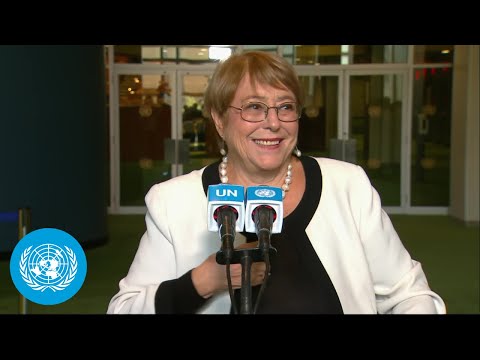
Michelle Bachelet presents candidacy with focus on U.N. reform, prevention and women's rights
Summary
Michelle Bachelet, jointly nominated by Brazil and Mexico for U.N. Secretary-General, laid out a platform prioritizing United Nations reform, prevention and stronger multilateral cooperation, and defended her support for women’s rights when pressed about a U.S. congressional letter opposing her candidacy.
Michelle Bachelet, the candidate jointly nominated by Brazil and Mexico for U.N. Secretary-General, opened a press session by calling for a United Nations that "upholds the principles and purposes enshrined in the charter" and said the organization must be "more agile, more efficient, more responsive" to deliver results for people.
Bachelet framed her candidacy around structural reform, stronger prevention and a renewed push for multilateralism. She said the next secretary-general should be highly visible in the field, devote time to early-warning and prevention capacities, and use the office’s good offices to build dialogue among member states. "We need a UN that is more agile, more efficient, more responsive, and more focused on delivering with results for the people we serve," she said.
Why it matters: Delegates and capitals are watching whether a candidate can both protect the U.N.'s founding principles and persuade powerful member states — particularly the five permanent Security Council members — to back substantive changes. Debate over Security Council reform and the role of the veto featured repeatedly in questions from the press.
On a question from Edith Lederer of The Associated Press about a recent letter from U.S. lawmakers that labeled her a "pro-abortion zealot," Bachelet said she "truly believe[s] in women's rights" and stressed that, as secretary-general, she would work to implement existing intergovernmental agreements such as the Beijing Platform for Action, the outcomes of the International Conference on Population and Development in Cairo, and CEDAW. "As Secretary-General, my role will be to ensure the United Nations... that Beijing is still there, is valid, and we need to continue pushing," she said.
Pressed on the risk of a veto by the United States, Bachelet acknowledged that "the veto exists on the five permanent members" and that any candidate can be blocked. She said she would seek to maintain working relationships with all member states, powerful or less powerful, and noted past experience working with the United States while serving as president.
Asked what sets her apart from other candidates, Bachelet pointed to her record in government and mediation: she cited two terms as president, a term as defense minister, work on transitional justice after dictatorship, and experience chairing regional bodies such as UNASUR where she said she used "silent diplomacy" to defuse crises.
On Security Council reform, Bachelet said the decision rests with member states but pledged to "do my best to convince with my good offices" and to work with the General Assembly and broader membership to press for changes that improve representation and help overcome deadlock. She said meaningful reform requires both regional and gender representation.
The session concluded with Bachelet emphasizing persistence and dialogue as the practical tools she would use, saying she would "do my biggest effort" to strengthen the multilateral system and that the United Nations must show people it "delivers" in order to maintain legitimacy.
Next steps: The selection and formal decision process will be carried out by member states; Bachelet said she would press the case for prevention, visibility, and institutional reform if chosen.