Get Full Government Meeting Transcripts, Videos, & Alerts Forever!
Get email alerts on the Program Of Studies topic
No spam. Unsubscribe anytime.
Stafford board debates dual-enrollment sequencing and why small DE math classes run while arts and languages are cut
Summary
Board members pressed staff about why a small, seven‑student dual‑enrollment linear-algebra/differential-equations sequence is running while some upper-level language and arts classes were canceled; staff cited master-schedule timing, teacher certification and late enrollment drops and said associate-degree pathways are being piloted where qualified teachers exist.
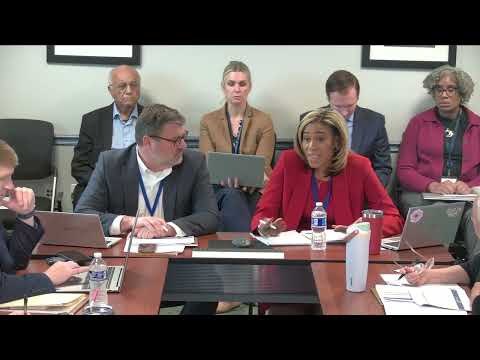
The Stafford County School Board reviewed proposed program-of-studies changes for 2026–27 and spent much of the session probing how the division decides which advanced courses to run.
Board members questioned why a DE linear algebra/differential equations sequence that now enrolls seven students across multiple sites will be kept in the schedule while German 4 and AP art sections were canceled at some schools. "We were at roughly 15 students across the division," Dr. Robertson said when explaining how student course requests and late schedule changes affected section decisions; after late drops the local count for the DE class fell to seven.
Staff and presentation lead Mr. Bowling said recent legislation and local planning permit the division to package existing dual‑enrollment and AP courses into associate-degree pathways and to offer those pathways at schools where teacher certification exists. "We are going to be offering these programs and looking at how we can market them better," Mr. Bowling said, noting that the division has prioritized locations with qualified teachers.
Board members and parents argued the current approach creates inequities: several speakers said that advanced math offerings seem to be preserved while arts and upper-level language courses are harder to sustain because of schedule stacking, classroom capacity and teacher willingness to teach combined levels. Staff described multiple constraints: differing staffing allotments by school, teachers' qualifications for DE sections, classroom capacity, and timing of master-scheduling decisions. Staff said they are exploring stacking, rotating teachers across schools and virtual combinations where pedagogically appropriate.
Members also pressed for a stronger middle‑school pipeline into CTE and trades programs; several board members said lack of exposure in middle grades reduces future CTE enrollments in masonry, carpentry and similar fields. Staff proposed more in-person outreach, center tours and earlier marketing to build those pathways.
The board asked staff to return with clearer staffing standards, stronger enrollment-disclosure language to families (a disclaimer that course enrollment and teacher availability can affect whether a class runs), and follow-up one‑on‑one briefings ahead of final program-of-studies adoption in November.