Get Full Government Meeting Transcripts, Videos, & Alerts Forever!
Get email alerts on the Feeding Our Future topic
No spam. Unsubscribe anytime.
Legislators say oversight failures helped Feeding Our Future fraud; auditor urges fixes, MDE details reforms
Summary
A legislative hearing reviewed the Office of the Legislative Auditor—s June 2024 special review of Feeding Our Future, with the auditor saying MDE—s oversight was inadequate and the state agency outlining reforms including a new OIG and in-house counsel; members pressed for records and criticized absent officials.
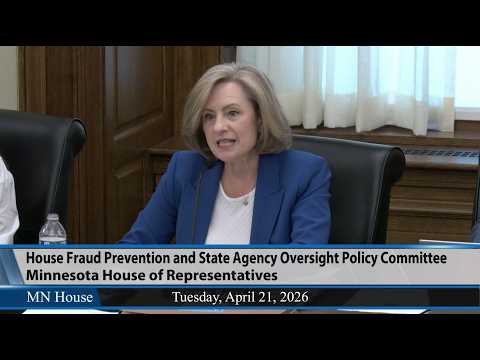
The House Prevention and State Agency Oversight Committee heard a June 2024 Office of the Legislative Auditor special review that found the Minnesota Department of Education—s oversight of the Feeding Our Future nonprofit was inadequate and created opportunities for fraud.
Deputy Legislative Auditor Catherine Tyson told the committee the review found MDE repeatedly approved Feeding Our Future—s applications and paid large reimbursements despite prior administrative reviews and complaints. "The best defense against fraud is effective oversight and strong internal controls," Tyson said, summarizing the report—s central finding that earlier warning signs were not acted on.
The LA reported that Feeding Our Future expanded rapidly during the pandemic: at peak MDE paid nearly $32 million for roughly 12 million meals and snacks, an increase the audit said was an outlier compared with other sponsors. The audit identified repeated failures by MDE to verify sponsor information, to adequately investigate complaints, and to initiate a federal serious-deficiency process despite evidence of inflated meal claims and other compliance problems.
MDE deputy commissioner Martin Hold it said the fraud was "a travesty" and that the department has since built investigative capacity. "We now have a robust agency-wide approach to preventing fraud, waste and abuse," he told the committee, describing a new Office of Inspector General, an in-house Office of General Counsel and expanded program-integrity staff. He cited 412 complaints received by the OIG (closed 170), 234 cases under investigation and 66 full investigations as of April 15 (the department reported using temporary sanctions and recovering program savings).
Committee members pressed officials for specifics they said remain unclear: who authorized resumption of payments to Feeding Our Future in April 2021, what records document MDE—s contacts with USDA investigative offices, and what role the Attorney General—s office played when it represented MDE in litigation. Members noted Attorney General Keith Ellison declined the invitation to testify and instead submitted a letter that the committee posted.
The committee also screened a 2020 video of Rep. Ilhan Omar discussing the Meals Act provision in the Families First Coronavirus Response Act that loosened on-site consumption rules. Members said the legislative intent and subsequent administrative interactions deserve explanation from the author and from agencies that implemented the waiver.
Tyson told the committee that federal pandemic waivers did not eliminate MDE—s ability to focus on high-risk sponsors; the LA concluded MDE made choices that reduced oversight and that the agency had authority to seek legislative or regulatory changes sooner. Tyson said the LA recommended statutory clarifications and improvements to complaint investigation procedures; some responsive statutes were enacted in 2023 and 2025, she noted.
Deputy Commissioner Hold it said MDE tried to work with federal partners and requested USDA OIG assistance in late 2020 but received limited help; he said the department has increased its internal disciplinary and exclusion authorities and now uses them more aggressively. "It has allowed for an incredible learning curve and more effective oversight," he said.
The committee requested that MDE provide records of its contacts with USDA OIG and any affidavits or communications that relate to the agency—s decision-making during 2020'121, and asked for documentation of who signed off on removing a stop order in April 2021. Members said those records are necessary to determine accountability for decisions that preceded federal indictments and civil actions.
The hearing closed with members urging follow-up: some urged statutory expansion of prosecutorial authority and statute-of-limitations changes for fraud cases, while others emphasized improving state-level investigative resources and interagency cooperation. The committee said it will post witnesses—materials and follow up on the requested records.
Next steps: the department agreed to provide available correspondence and follow-up materials, and the committee said it will continue oversight work to ensure recommendations from the LA are implemented and outstanding questions are answered.