Get Full Government Meeting Transcripts, Videos, & Alerts Forever!
Get email alerts on the Economic Mobility topic
No spam. Unsubscribe anytime.
Dubuque City officials outline economic mobility progress, data on poverty and service access
Summary
City staff presented a progress update on economic mobility initiatives, citing a 5-year poverty rate of 12.7%, gaps in grocery-store access for thousands of residents, and plans to co-create a community roadmap with partners funded in part by a Gates Foundation grant.
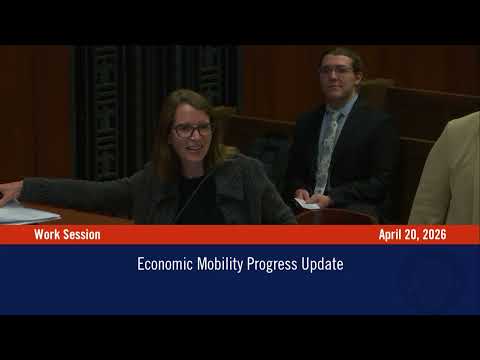
Dubuque City officials presented an economic mobility progress update April 20, saying the office is moving to coordinate data, neighborhood engagement and partner services to reduce poverty and improve access to opportunity.
The briefing—delivered by Community Impact and Neighborhoods Support Director Antonio Mozzan, Special Assistant for Economic Mobility Karen Rothblum and IT data analyst Braden Daniels—reported a five-year Census poverty rate of 12.7% for the city, highlighted geographic disparities concentrated in census tracts 1 and 5, and described outreach and mapping work intended to connect residents to services.
Why it matters: city staff said the effort aims to align systems across government and nonprofit partners so residents can better find work, services and supports. Officials emphasized that the work will rely on data-driven measures, ecosystem mapping and direct community co-creation rather than top-down program rolls.
Mozzan described the office’s mission as “to build a thriving, connected, and empowered community by aligning systems, removing barriers, and activating residents,” and framed the department as a “backbone” for coordinating partners and eliminating duplication.
Rothblum, who said she joined the city three months ago as a special assistant for economic mobility, said her position is one of 16 similar roles funded through a Gates Foundation grant administered via the International City/County Management Association (ICMA). She said ICMA and the Urban Institute provide peer-learning and analytic support for the work.
Data analyst Braden Daniels explained the city’s use of both one-year and five-year Census poverty measures and said the one-year rate rose between 2023 and 2024. “Still, that 5-year poverty rate of 12.7% puts us at the fourth lowest of the 11 largest cities in Iowa,” he said, while adding that some neighborhoods have rates well above the city average.
Daniels also presented a city map of grocery-store coverage: roughly 25,000 residents fall within a half-mile buffer of stores that meet a USDA thrifty food plan, while about 35,000 residents are outside those buffers. He noted that in the highest-poverty neighborhoods about 25% of households do not have a vehicle, a barrier to accessing food and services.
Council members asked how neighborhood associations would be used; staff said they are reimagining associations to play roles in information-sharing, advocacy and co-creating local solutions. Officials also said the city has begun large-scale outreach—door-knocking and other direct engagement—and plans additional coordinated surveying and engagement to gather resident perspectives.
Council member Wel urged including case studies or individual client stories to illustrate program impact; staff said a few examples are planned for upcoming sessions. Council member Cell asked for funding details; Rothblum confirmed the Gates Foundation grant and the ICMA/Urban Institute partnership.
Next steps: staff said they will produce an executive summary of the initiative, complete a community resource and investment assessment, and pursue co-creation activities to develop a shared community roadmap. The presentation was characterized as a preview of a fuller engagement session scheduled for the next day.