Get Full Government Meeting Transcripts, Videos, & Alerts Forever!
Get email alerts on the Child Protection topic
No spam. Unsubscribe anytime.
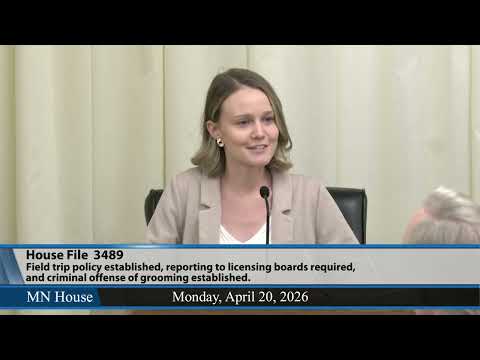
Survivor testifies as Minnesota panel advances bill to criminalize grooming and strengthen school protections
Summary
The Ways and Means Committee advanced House file 3489 as amended after survivor testimony and law‑enforcement and fiscal briefings; the bill would define grooming as a felony, expand mandatory reporting and tighten supervision rules, with committee members flagging fiscal staffing needs for implementation.
A Minnesota House Ways and Means Committee advanced a bill that would explicitly criminalize child grooming and strengthen school supervision and reporting requirements after emotional testimony from a survivor and supporting testimony from law enforcement.
Hannah Low told the committee she was groomed and sexually assaulted by a high‑school band teacher from 2012 to 2016, describing years of manipulation, isolation from friends and family, and a final assault on her last day of high school. "He slowly began to isolate me from friends and family, normalized touching me and communicating as if we were close friends," Hannah Low said. "Five-plus years of grooming was even more harmful to my long‑term health and well‑being than the assaults themselves." (Testimony identified in the committee record as Hannah Low.)
Detective Chad, who investigated the case, said the criminal inquiry found probable cause the teacher sexually assaulted the student but that statutory and administrative limits in 2016—including a three‑year look‑back limit for the Department of Education—prevented some administrative findings and actions. The detective told the panel that defining grooming in statute would close gaps that currently hinder charging and administrative remedies.
Representative Peggy Bennett, who introduced the amendment and described why she brought the measure forward, said the bill grew from constituent accounts and reporting that revealed multiple victims. She told the committee the proposal "strengthens protections for students against sexual grooming, clarifies field‑trip supervision, creates a new felony offense for child grooming, improves mandatory reporting and enhances training to include grooming." (Sponsor remarks as transcribed.)
Nonpartisan fiscal staff and education staff briefed the committee on the bill’s fiscal note. The amendment added funding the Department of Education said it would need for additional investigative staff to implement the proposal; the fiscal note in committee materials breaks out investigative FTE needs and estimates a per‑FTE amount in the transcript (approximately $185,020 per FTE cited in discussion). Committee members pressed MDE and fiscal staff about whether the proposed funding would be ongoing and about the staffing mix (whether staff would be sworn law‑enforcement officers or administrative investigators). MDE’s representative (transcribed as "ago Shuni," director of government relations) and fiscal analysts said details and exact costs were in the fiscal note and subject to refinement as the bill moves through the process.
Committee members from both parties praised the survivor for testifying and endorsed the policy goal but also highlighted fiscal concerns. Several members urged the authors to work with counterpart committees and the Senate on funding and technical fixes before final passage. The chair moved the bill "as amended" to the General Register; committee members approved the motion by voice vote and the bill was sent forward.
What happens next: The bill was advanced from Ways and Means to the General Register. Members noted the measure can be amended on the House floor and that funding and statutory language may change during negotiations with the Senate.
Notes on the record: The transcript contains inconsistent references to the bill number (transcribed as both "34 89" and "35 89" in different places); the committee materials should be consulted for the official House file number and bill text. Where a name or spelling was unclear in the transcript (for example, several administrative staff and one detective’s surname), this article uses the spelling as presented in the committee record and flags those items for verification.