Get Full Government Meeting Transcripts, Videos, & Alerts Forever!
Get email alerts on the Economy topic
No spam. Unsubscribe anytime.
ESCAP report warns Asia‑Pacific growth is slowing and urges a just energy transition
Summary
Hamza Malik of ESCAP outlined a slower post‑pandemic recovery for Asia‑Pacific, flagged the Middle East conflict and rising protectionism as near‑term risks, and said energy transition must be paired with macroeconomic stability and targeted social measures to avoid harming vulnerable groups.
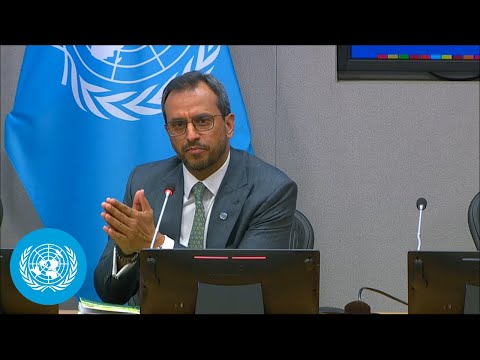
Hamza Malik, director of macroeconomic policy and financing for the United Nations Economic and Social Commission for Asia and the Pacific (ESCAP), launched the commission’s annual Economic and Social Survey of Asia and the Pacific in New York, saying the region’s post‑pandemic recovery remains below pre‑pandemic levels and faces fresh risks from geopolitical shocks.
"The pre‑pandemic average growth was around 5.5% and it's been hovering lower," Malik said in his opening remarks, and the report projects regional growth near 4% for 2026 under the baseline scenario. Malik told reporters the publication was closed for data and forecasting on March 17, and that the team incorporated a targeted assessment of the Middle East conflict into scenarios and footnotes.
The report sets out two central policy priorities for member states: bolster domestic and regional sources of demand to support growth, and pursue energy transition strategies that safeguard macroeconomic stability and household welfare. Malik emphasized the trade‑offs inherent in reforming fossil‑fuel subsidies: cutting subsidies can lower emissions, raise labor productivity and produce fiscal savings, but can also raise consumer prices and increase poverty if not accompanied by compensating measures.
"Energy transition will only succeed if it is accompanied by macroeconomic stability, economic growth and people's well‑being," he said, summarizing the theme chapter. The report analyzes roughly 16 policy instruments, with case studies that assess feasibility across countries’ fiscal, monetary, governance and technological capacities. Malik cited Korea and Thailand as examples where boosting renewables is more feasible, and highlighted political‑economy constraints that can delay reforms.
Report authors recommend institutionalized, early stakeholder dialogue to build legitimacy for reforms and suggested targeted, temporary fiscal support to protect vulnerable groups during transitions. On fiscal measures, Malik recommended temporary assistance aimed at lower‑income households, arguing that such targeting preserves social welfare without permanently increasing debt burdens.
In response to questions, Malik said recent events in the Middle East were reflected in three assessment buckets: immediate observable impacts (oil prices, currency moves, freight costs), near‑term effects likely to appear in macro data in the following months (inflation, trade and remittances), and longer‑term channels affecting poverty and employment if the conflict is prolonged. He also said the team reduced its 2026 growth estimates for both China and India—the two largest contributors to the regional average—to reflect those risks.
When asked about debt‑vulnerable countries, Malik noted that detailed debt‑vulnerability analysis had been a focus of prior ESCAP editions and referred reporters to a UNCTAD‑led "World of Debt" resource for updated country‑level data. He added that debt vulnerability depends on financing conditions and capacity to service debt, not on debt‑to‑GDP ratios alone.
The briefing concluded with Malik saying ESCAP will follow the New York launch with a series of policy dialogues across member states, including a planned launch in Bangkok and targeted events to discuss country‑level implications.
The full Economic and Social Survey of Asia and the Pacific and accompanying materials are available online; Malik said hard copies were available at the venue and that ESCAP staff will hold follow‑up country discussions through May–August.