Get Full Government Meeting Transcripts, Videos, & Alerts Forever!
Get email alerts on the Municipal Governance topic
No spam. Unsubscribe anytime.
Iowa League of Cities gives Nevada council a refresher on home rule, mayor duties and ethics
Summary
Mickey Shields of the Iowa League of Cities led a workshop for Nevada city officials covering home rule, mayor–council powers, conflict-of-interest rules and gift-law limits, and flagged state property-tax proposals that could affect local budgets.
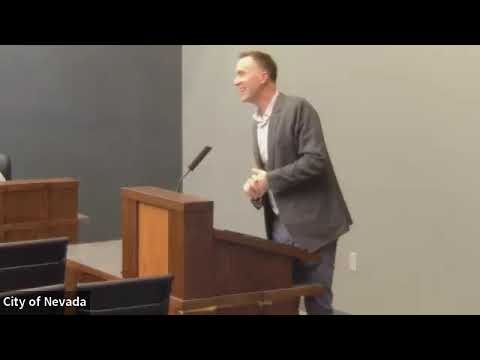
Mickey Shields, deputy director of the Iowa League of Cities, opened a council workshop by telling Nevada officials the session would be a refresher on ‘‘the basics of city government’’ and distributed a printed handout for reference. "I'm Mickey Shields. I'm the deputy director with the Iowa League of Cities," she said.
Shields reviewed municipal home rule under the Iowa Constitution and stressed that local regulations may not conflict with state or federal law, advising officials to consult their city attorney for complex questions. She told the council that most Iowa cities use the mayor–council form of government — ‘‘you have options to add in a city administrator position’’ — and cited membership figures used in the presentation to describe statewide norms: roughly 937 incorporated Iowa cities, about 97% using mayor–council and roughly 24 using council–manager arrangements; about 200 cities have an appointed city administrator.
On mayoral powers, Shields summarized provisions in Iowa Code section 372.14 (emergency proclamations and some representational duties) and noted that in the mayor–council form the mayor generally does not vote except in limited circumstances identified by state statute. She explained veto mechanics: a mayor may veto an ordinance or resolution in writing within 14 days of passage and the council then has 30 days to override with a two-thirds vote.
Shields spent significant time on ethics and conflicts of interest, citing Iowa Code chapter 68B and urging disclosure and abstention where a council member would directly benefit from a vote (for example, voting on a contract for a business the member owns). She noted carve-outs the League had highlighted: competitively bid contracts and small contracts under $6,000 may be handled differently in the statute.
The deputy director also reviewed the gift law and practical compliance tips — including a modest daily exception noted in the handout — and suggested commonsense approaches such as placing holiday gift baskets in a public area at city hall to avoid appearance-of-influence problems.
Shields closed by answering council questions about state legislative items. She told the council the League had circulated a property-tax model for members that reflects recent Senate amendments and urged officials to consult staff and legislators about potential budgetary impacts. "Talk to your staff for sure — they've probably seen it and played with the model," Shields said.
The presentation concluded ahead of the council's regular meeting; Shields left materials with staff and offered follow-up assistance through the League.