Get Full Government Meeting Transcripts, Videos, & Alerts Forever!
Get email alerts on the State Legislation topic
No spam. Unsubscribe anytime.
Michigan House advances guardianship assistance, eases retiree work limits and extends nurse licensing cycle
Summary
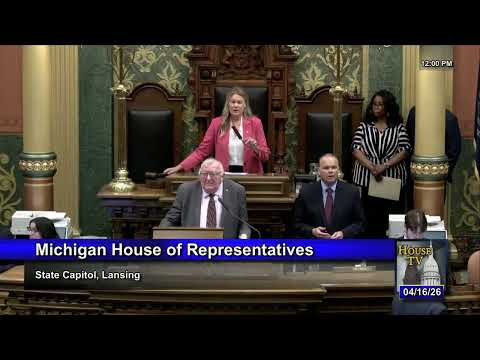
The Michigan House on April 16, 2026, passed a package of bills including two updates to the Guardianship Assistance Act, a measure lifting a 1,000-hour cap for certain retired county employees returning to work, and a change extending nursing and speech-pathology license cycles from two to three years.
Lansing — The Michigan House of Representatives on April 16 passed several measures aimed at supporting children in out-of-home care, county workforce stability and health-care professionals' administrative burdens.
Representative Young, speaking in support of the guardianship assistance package, said the bills would "ensure that relatives and licensed foster parents who have already been caring for a child can access guardianship financial assistance in clear and consistent ways," adding that "when caregivers can receive support more easily, children are more likely to remain in consistent family-based homes." The House passed House Bill 4696 on final passage by recorded roll call, 101 yeas and 3 nays, and House Bill 4697 by the same margin, 101 yeas and 3 nays. Both bills were moved for immediate effect and ordered to take effect immediately.
The two bills (introduced as part of a package read by the clerk) update Michigan's Guardianship Assistance Act to remove certain barriers and extend eligibility to relatives approved by the Department of Health and Human Services, supporters said during floor remarks.
Representative Harris described House Bill 4471 as a staffing and public-safety measure that "allows dedicated public servants to continue giving back to their communities without risking their hard-earned retirement benefits." The bill removes the statutory 1,000-hour cap that can limit how much certain retired county employees — including those returning to sheriff and prosecutor offices — may work after retirement. The House approved HB 4471 on final passage, 100 yeas and 4 nays, and ordered immediate effect.
On professional licensing, Representative Thompson said House Bill 4901 is a "bipartisan win for our fellow nurses," explaining the bill moves registered nurses, licensed practical nurses and speech-language pathologists from a two-year to a three-year license renewal cycle to reduce fees and administrative burden while leaving continuing-education requirements unchanged. The House passed HB 4901 unanimously, 104 yeas and 0 nays, and ordered immediate effect.
The chamber also adopted a series of nonbinding resolutions recognizing County Government Month and other commemorations, read a memorial resolution honoring former Representative James McBride and referred several investigatory resolutions — including a select-committee referral related to the Interlochen Center for the Arts and a request asking the U.S. Department of Justice to investigate persons named in the Epstein files — to the Committee on Government Operations.
Votes at a glance
- HB 4696 (Guardianship Assistance Act amendment): Passed 101–3; immediate effect ordered. (Sponsor listed by clerk: Representative Mirman; floor sponsor and proponent: Representative Young.) - HB 4697 (Guardianship Assistance Act package): Passed 101–3; immediate effect ordered. (Sponsor: Representative Young.) - HB 4471 (removes 1,000-hour cap for certain retired county employees): Passed 100–4; immediate effect ordered. (Sponsor: Representative Harris.) - HB 4901 (extend nursing and speech-language license cycle to three years): Passed 104–0; immediate effect ordered. (Sponsor: Representative Thompson.)
What happens next
The clerk recorded passage of the bills and the House ordered immediate effect where moved; the measures will be transmitted for executive action or implementation consistent with state rules. Several investigatory and referral resolutions were sent to committee for further consideration. The House adjourned until April 21, 2026, at 1:30 p.m.
Sources: Floor remarks and roll-call tallies read aloud by the clerk on the House floor during the April 16, 2026 session.