Get Full Government Meeting Transcripts, Videos, & Alerts Forever!
Get email alerts on the Public Safety topic
No spam. Unsubscribe anytime.
Central council weighs three options for the future of local law enforcement
Summary
At a lengthy April 14 non-action discussion, the Central City Council reviewed a select committee report recommending three paths for policing: a stepped contract with the parish sheriff (escalating to $2.515 million in year five), a full-time Central Police Department (estimated ~$4.6 million annually), or a hybrid model keeping a smaller CPD alongside a sheriff contract. Council members asked for more detail and scheduled presentations at the April 28 meeting.
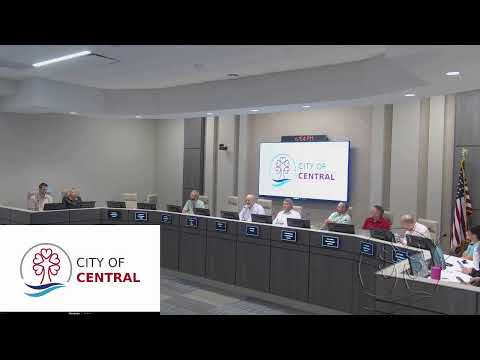
Council member Lavern presented the select committee’s year‑long review of law‑enforcement options on April 14, laying out three distinct choices for the city: a phased contract with the parish sheriff, a standalone Central Police Department (CPD), or a hybrid that preserves some CPD functions while contracting others to the sheriff’s office.
"The proposed contract with the Sheriff's Department would be stepped in terms of cost: $500,000 for the first year, a million for the second, 1.5 for the third, 2 million for the fourth year and ... 2.515 million at the fifth year," Council member Lavern said, summarizing figures the committee discussed. He characterized the committee’s role as informational and emphasized the need for more detailed contract language before any vote.
Why it matters: the choice carries large budgetary and operational consequences. A full‑time CPD would cost an estimated $4.6 million a year, according to the committee’s estimates, increasing the city’s long‑term personnel and retirement obligations; the sheriff contract would shift many operational responsibilities to a county law‑enforcement agency while promising phased pricing at lower upfront cost.
Council members pressed on coverage, local control and long‑term costs. "You lose local control with a contract with the Sheriff's department," Council member LaVarne said, noting that deputies assigned through a contract might not be as locally dedicated as city officers. Other members raised the risk that a sheriff‑only approach could leave the city short on local responders during large regional calls; Captain Demoulin and Officer Dothiere—both of whom served on the committee—were asked to return with operational details.
Pension and competitiveness also figured in the discussion. Several council members questioned IMPERS contribution rates for a municipal police force and how rising contribution demands might affect a small city’s ability to sustain a CPD. "What does that look like in five years?" one council member asked, noting that retirement rate increases or larger regional pay could make local recruitment and retention harder.
The council also discussed process and timing: an attorney general’s opinion requested earlier has not yet been received, and council members suggested workshop‑style meetings to examine coverage metrics, response‑time expectations and concrete contract language.
Next steps: the council agreed to invite presentations—both from the sheriff's office and from CPD leadership—at the April 28 meeting or a dedicated workshop so members can ask detailed budgeting and coverage questions before any formal motion.
The discussion, while lengthy, was non‑binding; no formal motion or vote on a policing model was taken at the April 14 meeting.