Get Full Government Meeting Transcripts, Videos, & Alerts Forever!
Get email alerts on the Agriculture Policy topic
No spam. Unsubscribe anytime.
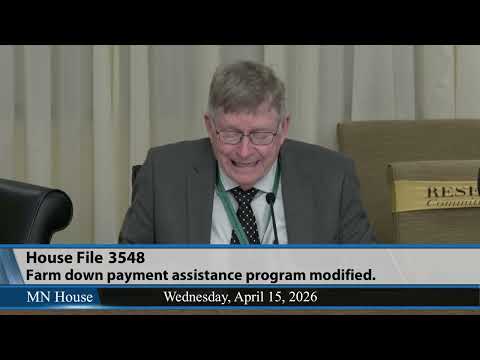
House Agriculture committee lays over Rep. Anderson’s bill after split votes on funding and policy amendments
Summary
The Minnesota House Agriculture Finance and Policy Committee on April 15, 2026 considered House File 35‑48 (a package with a down‑payment assistance program and other agriculture provisions). Multiple amendments were adopted but the final bill failed a roll call, 6–8, and was laid over. Testimony emphasized keeping $20,000 grant caps for beginning farmers.
ST. PAUL — The Minnesota House Agriculture Finance and Policy Committee on April 15, 2026 laid over House File 35‑48 after a divided roll‑call vote, after members traded amendments over funding priorities, farm‑transition services and chemical restrictions.
Representative Terry Anderson, the bill sponsor, opened the meeting by moving House File 35‑48 and presenting a D4 amendment he described as compromise language focused on a down‑payment assistance program. Anderson told the committee the amendment would prevent previously appropriated funds from reverting to the General Register at the end of the fiscal year and would allow the department to retain the funds through June 30, 2030; he said $801,000 reverted in 2025 under prior language.
Laura Schreiber, government relations director for the Land Steward Project, testified in support of the bill and urged that individual grants remain capped at $20,000 so “more farmers can access this fund.” She told the committee the timeline changes in the amendment would help ensure funds are distributed rather than returned.
The committee considered a series of amendments. The A23 amendment — described as aligning the bill with the governor’s budget request and department policy proposals — was adopted, as were A17 (allowing certain eggs and pastured poultry to be donated to food assistance programs under defined packaging, refrigeration and distribution rules), A16 (a one‑year extension for meat‑cutting provisions), A18 (adjusting per diem rates for non‑representative committee members), and A19 (a roughly $20,000 reallocation to farmland transition services for mediation, contract and business planning help for beginning farmers).
Rep. Nelson moved A22, which increased compensation for wolf depredation claims to 80% of market value and shifted some money into the local food purchasing program. After extended debate and a requested roll call, that amendment passed, recorded as 8 ayes and 6 nays.
Rep. Burkle’s A21 — which would have removed a specific requirement aimed at preventing physical contact between farmed and wild animals from the farm‑survey language — produced stronger disagreement. Supporters said the containment requirement and its costs were driving some deer farmers out of business; opponents warned the change could increase disease‑spread risk. The roll call tied 7–7 and the amendment did not prevail.
The committee also discussed a separate proposed ban on the herbicide paraquat (I‑24). Rep. Hanson urged advancing a paraquat ban, citing evidence of health harms; Rep. Anderson said there was no movement on that proposal from his side and Rep. Hanson chose not to move the amendment to avoid a negative vote.
After adopting the DE4 as amended, the committee held a final roll‑call on House File 35‑48 as amended. DFL members on the panel called for a no vote in part because the paraquat ban was not included; the roll call recorded 6 ayes and 8 nays, so the motion did not prevail and the bill was laid over. The committee recessed briefly and then adjourned.
Votes at a glance
- Approval of April 13 minutes: adopted (voice vote). - A23 (governor’s budget/policy alignment): adopted (voice vote). - A17 (food donation/eggs): adopted (voice vote). - A16 (meat‑cutting extension): adopted (voice vote). - A18 (per diem adjustment): adopted (voice vote). - A19 (reallocate ≈$20,000 to farmland transition services): adopted (voice vote). - A22 (wolf depredation 80% compensation; local food funding): adopted, roll call 8–6 in favor. - A21 (remove containment requirement in farm survey language): tied roll call 7–7, did not prevail. - DE4 as amended: adopted (voice vote). - House File 35‑48 as amended: roll call 6–8, did not prevail; bill laid over.
Why it matters
House File 35‑48 bundles several policy changes that affect beginning farmers, food donation rules, compensation for livestock losses and department policy alignment with the governor’s budget. Supporters described the bill as providing needed flexibility to get appropriated funds into the hands of farmers and to stand up programs that help with farmland transitions. Opponents raised public‑health and safety concerns (notably regarding a potential paraquat ban and disease‑containment language for farmed deer) and signaled that those unresolved issues contributed to the final layover.
What’s next
The committee recessed to the call of the chair and adjourned; because the bill was laid over rather than advanced, sponsors and interested stakeholders may continue negotiations and could return the bill or components of it to committee at a later date.
","sections":{"lede":"The Minnesota House Agriculture Finance and Policy Committee on April 15, 2026 laid over House File 35‑48 after a 6–8 roll‑call defeat of the bill as amended, following debate over a down‑payment assistance program, wolf‑depredation compensation, and a proposed paraquat ban.","nut_graf":"Representative Terry Anderson sponsored the package and said a key change in the D4 amendment would prevent appropriated funds from reverting to the General Register — Anderson said $801,000 reverted in 2025 — while testifiers urged keeping individual grants at $20,000 to maximize access for beginning farmers. The committee adopted several targeted amendments but split on items tied to public‑health and wildlife policy, and the final vote failed, so the bill was laid over.","ending":"The committee recessed briefly and adjourned; sponsors indicated continued negotiations, and any return of the bill will depend on whether members resolve remaining disputes over containment rules and chemical restrictions."},