Get Full Government Meeting Transcripts, Videos, & Alerts Forever!
Get email alerts on the Affordable Housing topic
No spam. Unsubscribe anytime.
Committee hears bill to align Minnesota bond cap with federal change to expand affordable housing
Summary
House File 40234 would lower Minnesota's cap on tax-exempt private-activity bonds to mirror a federal change, allowing more projects to qualify for low-income housing tax credits and increasing private investment in affordable housing, supporters said. The committee laid the bill over for possible inclusion.
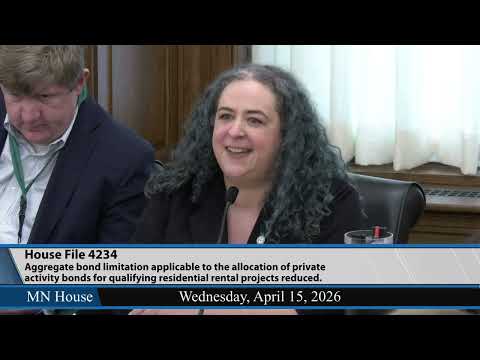
House File 40234, introduced to the Tax Committee April 15, would change Minnesota's cap on tax-exempt private-activity bonds to conform with recent federal law, a move supporters said would allow more affordable housing projects to access federal low-income housing tax credits without additional state dollars.
Representative Reyer introduced the measure and said the change "means more projects will be eligible for the tax credits and therefore...will be able to create and preserve more affordable housing in Minnesota without any additional state funds." Andrea Brennan, president and CEO of the Greater Minnesota Housing Fund, told the committee that bipartisan national estimates of the federal change could result in the production of "an additional 1.2 million housing units across the nation." She said Minnesota could see roughly nine more projects financed in a typical year and about $120 million more in private investment from credit sales.
A former commissioner of the Minnesota Housing Finance Agency who testified for the bill described the bill's two-tier cap (a 30 percent baseline, rising to 40 percent for certain projects) and said Minnesota Housing already adjusts allocations by underwriting needs. She and other testifiers said the proposal mainly reallocates existing federal resources rather than creating new state spending.
Committee members asked where projects would appear geographically; testifiers said while many bond-financed projects cluster in larger metro areas, allocations administered by Minnesota Housing serve greater Minnesota communities as well. No formal opposition was offered during the hearing.
The committee moved the author's amendment and the bill was laid over for possible inclusion in the 2026 tax bill. The next procedural step noted in committee was that the bill would be considered as part of a tax omnibus vehicle.