Get Full Government Meeting Transcripts, Videos, & Alerts Forever!
Get email alerts on the Contingent Faculty Insurance topic
No spam. Unsubscribe anytime.
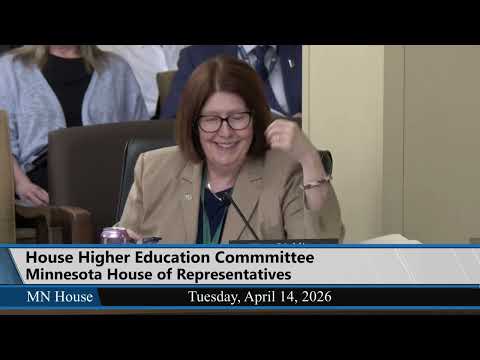
Committee hears bills to study contingent faculty insurance and clarify reasonable-assurance rules
Summary
Lawmakers heard two related items: House File 4368 to convene a work group on contingent faculty health-insurance access and House File 4889 addressing reasonable-assurance and written guarantees for adjuncts. Testimony included personal accounts of lost coverage and system caution about bargaining implications; both bills were laid over.
Representative Hansen (Representative Hinson introduced HF 4368) and Representative Hinson presented bills aimed at addressing the instability facing contingent (adjunct) faculty and options to improve access to employer-sponsored health coverage.
Faith Erickson, an English instructor at St. Cloud State and a technical college, testified that contingent faculty in the Minnesota State system face unpredictable schedules that can strip them of insurance coverage. "There are about 7,500 faculty in the Minnesota state system and about 3,700 of them are contingent faculty," Erickson told the committee, and she described multiple personal accounts in which small scheduling changes resulted in loss of insurance or dramatic premium increases. Erickson said contingent faculty frequently delay or forgo care and that the issue can have severe personal consequences.
Eric Davis, vice chancellor for human resources at Minnesota State Colleges and Universities, told the committee that health-insurance eligibility and thresholds are governed through collective bargaining and the state employee group insurance authority. Davis described recent contract changes that expand partial access and said the state bargaining agency (Minnesota Management and Budget) and bargaining partners should be included in any work group. He warned that statutory changes could create fiscal stress for the Minnesota State system and urged that representatives from bargaining and the state insurance authority participate in discussions.
Carl Newman and other faculty witnesses supported creating a work group to study eligibility thresholds, gaps and solutions, calling the approach measured and appropriate to examine a complex issue that intersects payroll, enrollment-driven assignments and collective bargaining. Members sought campus-level data on how many contingent faculty serve for long periods without conversion, and some asked for demographic breakdowns to assess disparate impacts; several members suggested the Unemployment Insurance Advisory Council and other data sources should be consulted.
Committee members expressed sympathy for contingent faculty concerns and acknowledged the potential cost and bargaining complications; several said a work group could help identify lower-cost or phased solutions. House File 4368 (work group) and the informational item on reasonable-assurance definitions (House File 4889) were laid over for further study and data gathering.
Ending: Both items were laid over; the committee requested campus-level and demographic data and asked staff to coordinate with bargaining authorities and the unemployment-insurance advisors as appropriate.