Get Full Government Meeting Transcripts, Videos, & Alerts Forever!
Get email alerts on the Guardianship Oversight topic
No spam. Unsubscribe anytime.
Audit finds weak oversight of adult guardianship in Minnesota; Legislature urged to centralize authority
Summary
An Office of Legislative Auditor review released in April found inconsistent oversight, low compliance with annual reporting, and limited complaint processes for adult guardianship in Minnesota and recommended a centralized statutory entity, mandatory training, and a formal complaints mechanism.
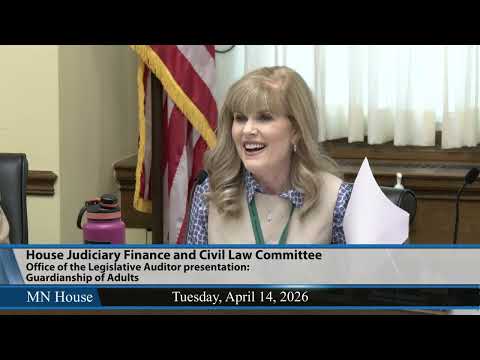
Deputy legislative auditor Rodriguez told the House Civil Law Committee on April 14 that the Office of Legislative Auditor(OLA) found ‘‘inadequate oversight of adult guardianship in Minnesota,’’ including weak monitoring of guardians and inconsistent enforcement across judicial districts. The audit said the state lacks clear statutory standards for how courts should monitor guardianship cases and relies heavily on reactive measures such as complaints or petitions to identify problems.
The OLA presented three principal findings: courts lack consistent oversight and enforcement practices; training requirements for guardians and judicial officers are inadequate; and the judicial branch lacks a statutory complaints process. Rodriguez said the OLA reviewed case files and found personal well-being reports were often sparse and late: of 260 reports sampled, only about 30% were submitted on time, and in a sample of 62 guardianship cases only one guardian had been removed for performance issues.
The OLA recommended the Legislature establish a centralized statutory entity responsible for administering and overseeing guardianship, set explicit oversight and enforcement duties for that entity, and require systematic reviews of guardianship cases. Rodriguez said such centralization could consolidate staff, improve consistency across Minnesota and enhance accountability.
Judicial branch representatives acknowledged gaps and described recent reforms. Audit manager Jamie Majors and senior attorney Kayla Do be said the branch had invested in online reporting tools (My Minnesota Guardian and My Minnesota Conservator), secured federal grants to fund complaint and investigative teams, and established centralized district teams to track late filings and monitor compliance. Majors said those reforms cut average complaint-closure time in the branchfrom 187 to 88 days and resolved over 1,000 cases identified during the audit period.
Committee members pressed both sides on specifics. Representative Feist asked whether complaints disproportionately implicate professional guardians or family guardians; OLA staff said the case files did not support a systematic comparison and cautioned that complaint data likely undercount problems because adults subject to guardianship often face barriers to filing complaints. Representative Kern and others raised concerns about the burdens placed on family caregivers to complete annual reports and the risks of financial exploitation when monitoring is weak. Rodriguez and Majors acknowledged the limits of current data and said statutory changes and funding would be required to implement OLA recommendations.
The committee did not take final legislative action on the audit itself. Members and staff asked the judicial branch to supply additional information comparing practices across districts and to return in writing to assist the Legislature in considering statutory changes.
Ending: The OLA urged the Legislature to act to bolster oversight, training and complaint mechanisms for adult guardianship; the judicial branch said it had made reforms but noted resource and statutory limitations. The committee held the audit discussion open for follow-up information to guide potential legislation.