Get Full Government Meeting Transcripts, Videos, & Alerts Forever!
Get email alerts on the Special Education Services topic
No spam. Unsubscribe anytime.
Special-education therapy pause leaves hundreds of students waiting; GDOE seeks emergency procurement and interim reimbursements
Summary
GDOE told the legislature that paused teletherapy services affected more than 600 students; parents were asked to use private insurance with GDOE covering a 20% co-payment while the department pursues an emergency procurement and cross-training of aides to cover shortfalls.
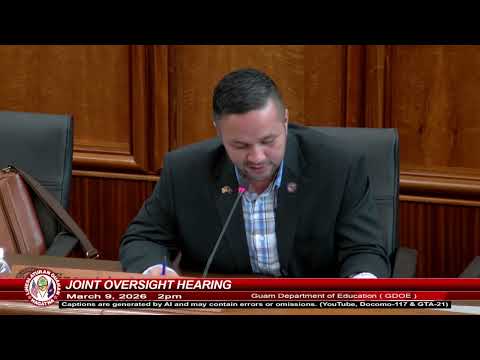
During the March 9 oversight hearing, GDOE officials described a sudden pause in contracted teletherapy services (referred to in testimony as TinyEye) that disrupted occupational and speech therapy for students with individualized education programs (IEPs).
Deputy Superintendent for Curriculum and Instruction Dr. Roselina Leewag told senators that 522 students require occupational therapy and 132 students require speech-language pathology services. "As an interim solution for now, parents were provided with a notice to temporarily seek services using their insurance with reimbursement for the 20% co-payment," she said.
GDOE said the contracted teletherapy vendor had paused services and that legal and procurement staff are preparing an emergency procurement to restore continuity. Superintendent Judy Wanet said emergency procurement is being pursued because the immediate need is "not something below $500,000" and the department is seeking governor's authorization to proceed quickly.
To address chronic staffing gaps, GDOE said it will cross-train roughly 700 existing aides so they can temporarily support onetoone special-education assignments during spring break and summer training windows. Leadership also described active outreach to retirees, allied-health providers licensed on Guam, EB-3 recruitment channels and the Department of Labor apprenticeship programs.
Senators repeatedly pressed for timelines and assurances for families. GDOE said it was balancing two priorities: restore services as quickly as possible to preserve the therapeutic relationship many students already have with therapists, and procure a long-term vendor to avoid repeated disruptions.
Officials also described higher pay and hourly contractual arrangements as potential incentives to attract licensed therapists. GDOE emphasized it would continue to reimburse families who use insurance while the department finalizes emergency contracting.
Parents, educators and attorneys who follow IDEA compliance will view the combination of a paused vendor and limited local clinical staff as an urgent operational failure; GDOE emphasized multiple stopgap and long-term strategies but acknowledged continued risk until contracts and recruitment succeed.