Get Full Government Meeting Transcripts, Videos, & Alerts Forever!
Get email alerts on the Procurement Finance topic
No spam. Unsubscribe anytime.
Guam education leaders report missing documents, disputed invoices and ARP timing risks during oversight hearing
Summary
New GDOE leadership told senators that short transition periods and incomplete procurement records have left tens of millions in refurbishment invoices unresolved; roughly $30M in ARP funds remain to be liquidated by March 31 and auditors flagged questioned costs tied to a $51M reimbursement.
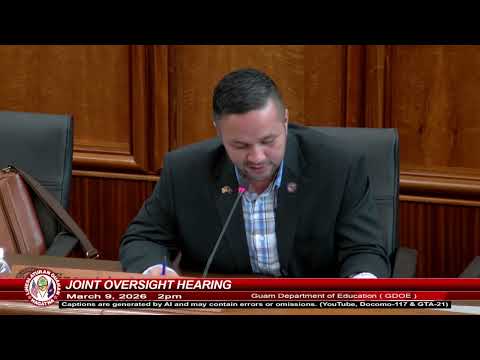
Senator Vince Borha, chair of the Guam Legislature's Committee on Education, Libraries and Public Broadcasting, opened a March 9 joint oversight hearing by saying constituents wanted clarity on long-running problems in the Guam Department of Education (GDOE). GDOE leaders acknowledged the department faces operational and documentation gaps uncovered after their arrival.
GDOE's new management team told the committee that many incoming deputies received only brief handovers—sometimes two half-days—and in several cases found missing files and cleared computers. "I hate to have to be the one to say this," one deputy said, describing empty workstations and absent procurement records that hampered continuity. The leadership said the gaps affected multiple projects, including HVAC work, campus refurbishments and therapy contracts.
Finance officials described how procurement pauses and contractor demobilization during a federal pause raised costs and left outstanding invoices. "We encountered several challenges during the leadership transition including expired or missing contracts, incomplete documentations such as invoices and change orders and delayed procurement processing," the superintendent's presentation said. GDOE described a large refurbishment program (12 schools) and an HVAC program involving thousands of units; some contracts required scope changes when contractors found wider problems than originally specified.
Deputy Superintendent for Finance Franklin Leang Guerrero told senators GDOE's total ARP allotment was $286.9 million and that about 90% of the ARP grant has been liquidated; the grant expires March 31, 2026. He said an estimated $30 million remains to be resolved and that additional invoices have surfaced for work that may fall outside ARP timelines. "We're cautiously optimistic that the majority of that is going to be allocated against ARP," he told the committee, but added that invoices still must be verified and supporting documentation provided.
GDOE's internal audit lead said a recent audit raised questioned costs and documentation gaps around the $51 million ARP transfer to local teacher payroll. That reimbursement has been drawn and is currently with GDOE, the internal auditor said, but audit testing identified deficiencies that mean GDOE is seeking a written program determination from the U.S. Department of Education before spending the funds further to avoid risk of repayment.
On contractor disputes, GDOE offered a practical approach used in one large contract: pay for equipment already procured using ARP funds but competitively rebid installation work after separating disputed installation charges, a strategy GDOE consulted with legal counsel and auditors to pursue. Leadership said they will maintain tighter document control going forward by routing invoices and purchase documents to a single business office desk and by instituting a master tracker for contracts and milestones.
Senators pressed GDOE for details and timelines. The department said it expects the remaining ARP reconciliations and contractor invoices to be clearer within weeks, but acknowledged the risk that some work may need to be paid from local lapse funds if federal rules do not permit later invoice acceptance.
The hearing record and deputy testimony indicate multiple moving parts—contract scope changes, late invoices, audit question costs and a tight ARP liquidation deadline—that together produce near-term risk to completing refurbishment work without additional local funding or a favorable federal determination. The committee requested additional spend-plan detail and said it would work with GDOE on possible statutory amendments to allow greater flexibility in using lapse funds for urgent infrastructure needs.