Get Full Government Meeting Transcripts, Videos, & Alerts Forever!
Get email alerts on the K 12 Education Funding topic
No spam. Unsubscribe anytime.
Newton County superintendent touts academic gains, warns of mounting funding squeeze
Summary
Superintendent Duke Bradley told the Newton County Schools Board of Education that student achievement and program access have improved across multiple measures, but he warned consecutive millage cuts and recent state tax changes have left the district with nearly $19 million less and growing fiscal pressure as it prepares a new five‑year plan.
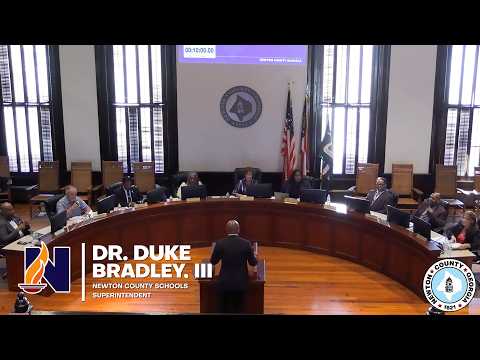
Superintendent Duke Bradley told the Newton County Schools Board of Education that the district has seen measurable gains in student outcomes while confronting significant fiscal challenges.
"We serve nearly 19,000 students across 24 schools, making us the 21st largest district in the state of Georgia," Bradley said as he opened his update, noting the district is also the county's largest employer with more than 2,500 staff. He framed the district's work around four themes — academics, operations, culture and engagement, and organizational stability and innovation — and outlined a set of initiatives intended to support those goals.
Bradley described three near‑term priorities: a state‑leading workforce development framework to strengthen pipelines into high‑demand careers; a soon‑to‑be‑released literacy blueprint to improve reading outcomes and support teachers; and the Newton County Schools Excellence in Teaching Framework to standardize and elevate classroom instruction.
On outcomes, Bradley presented multiple performance indicators. "In core academics, reading proficiency has improved in five of six tested grade levels, and math proficiency has increased in every grade, including ninth grade algebra," he said. He added that AP offerings rose from 25 to 32 courses with participation up nearly 19 percent and that the district has more than doubled its number of AP scholars. Eighth graders earning high‑school credit increased by about 40 percent and dual‑enrollment participation is "up over 100 percent," Bradley said. He also noted the district achieved four consecutive years with a composite graduation rate above 90 percent and four consecutive clean audits with zero findings.
Bradley pointed to improvements in accountability measures: "21 of our 24 schools over the past three years have improved their CCRPI scores, with six schools representing a quarter of the district posting double‑digit gains," he said, referring to the state College and Career Readiness Performance Index.
At the same time, he warned the district faces mounting fiscal pressure. "Our board has lowered the millage rate to 30‑year lows in consecutive years, amounting to nearly $19 million," Bradley said, adding that an outdated funding model, rising costs and a string of unfunded mandates have compounded the strain on local resources. He said Newton County ranks in the bottom third of Georgia districts for central office spending and staffing and that per‑pupil investment trails many regional peers; the district's financial efficiency rating, he said, is 2.5 on a five‑point scale.
Bradley criticized recent state tax changes as lacking "adequate safety nets for school systems," saying the legislation to reduce property taxes forces communities to choose between supporting students and protecting taxpayers, particularly seniors. He said district leaders have been working with the county's state delegation to propose alternatives.
Closing his remarks, Bradley highlighted student successes to underscore the district's work: Asia Lanum of Newton High (a member of the Georgia School Board Association Student Advisory) is headed to Howard University; Matthew Lynn, a graduating senior at Eastside High, was recognized for his theater work; and Cayden Gray is a two‑time district spelling‑bee champion.
Bradley said the district is developing its next five‑year strategic plan, which will replace the priorities that guided the past three years, and he asked the board for continued support and advocacy. "That concludes my remarks," he said.