Get Full Government Meeting Transcripts, Videos, & Alerts Forever!
Get email alerts on the Transportation Policy topic
No spam. Unsubscribe anytime.
Youth Commission to present protected‑bike‑lane policy to council after student research
Summary
Youth commissioners drafted a policy recommendation encouraging protected bike lanes near schools, citing research linking separated lanes to higher cycling rates and lower fatalities; they will present to the city council on May 4 and were asked to keep the proposal at policy level pending engineering review.
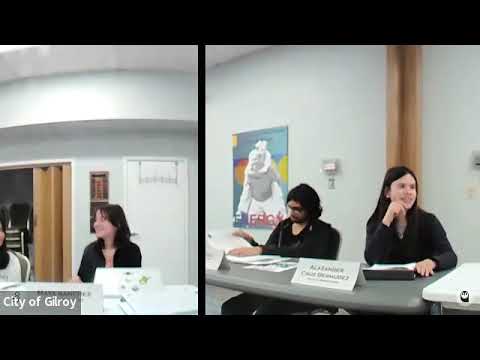
Youth commissioners presented research and a draft policy recommending that the city adopt a protected‑bike‑lane policy for new developments and school corridors and will deliver the recommendation to the city council on Monday, May 4.
Logan, one of the presenters, defined a protected lane: "A bike barrier is a physical form of separation between the bike lane and the main street or car," and outlined options including flexible delineator posts, bolards, raised medians and planters, noting trade‑offs in cost, durability and maintenance. Presenters emphasized that some options are inexpensive and quick to install but provide less protection; others (concrete or filled ballards, raised medians) provide stronger separation at higher cost.
Presenters and commissioners discussed practical challenges near Gilroy High School: loss of on‑street parking for nearby residents, construction and maintenance costs, debris accumulation in lanes, impacts on emergency access, and potential political pushback from businesses and neighbors. Commissioners asked presenters to describe mitigation options—such as timed parking controls or context‑sensitive designs—and to note that detailed cost and engineering analysis would rest with the city traffic engineer and public works department.
Presenters cited several studies and examples to support the policy idea: a suburban school project that increased student biking, a multi‑state U.S. analysis showing protected lanes increase bicycle commuting compared with painted lanes, and international research (Institute for Transportation and Development Policy) linking bicycle infrastructure to reduced fatalities. Presenters also referenced a case where a city removed and redesigned a protected lane within a year due to parking and emergency response concerns, at an estimated redesign cost cited in the presentation.
The commission was advised to keep the recommendation at a general policy level rather than prescribing specific hardware; staff and engineers will perform detailed design and costing if council directs further work. Commissioners decided to rehearse multiple speakers for the council presentation, and a staff follow‑up meeting with Anna was scheduled to consolidate the presentation.