Get Full Government Meeting Transcripts, Videos, & Alerts Forever!
Get email alerts on the Immigration Enforcement Policy topic
No spam. Unsubscribe anytime.
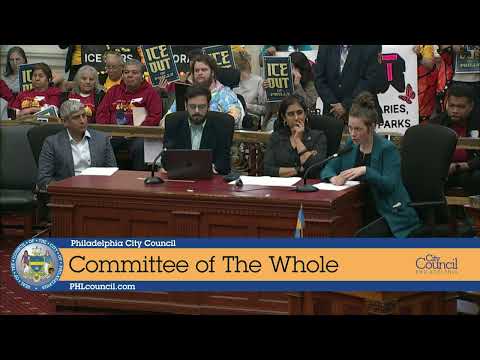
Committee moves seven "ICE Out" bills to full council after hours of testimony
Summary
The Committee of the Whole reported seven bills aimed at limiting city cooperation with federal immigration enforcement (bills 260056–260062) with favorable recommendations and suspended rules to permit first reading; hours of testimony from legal experts, community groups, business owners and faith leaders urged passage and stronger data‑access limits.
Philadelphia’s Committee of the Whole voted on voice motions Thursday to report seven bills known collectively as the “ICE Out” package to full council with favorable recommendations and a suspension of council rules to permit first reading at the next session.
The committee adopted amendments and passed procedural motions for bills numbered 260056 through 260062 after more than three hours of testimony from legal advocates, immigrant‑serving organizations, labor and business groups and dozens of residents urging robust limits on information sharing with federal immigration authorities.
The testimony opened with Vanessa Stein, senior staff attorney at the ACLU of Pennsylvania, who said the package is legally sound and rests on the Tenth Amendment’s anti‑commandeering principle and Fourth Amendment protections. “Choosing to minimize entanglement with abusive and discriminatory federal immigration enforcement programs is legally sound,” Stein said, and she urged provisions that would bar holds and data requests without a judicial warrant and require enforcement and reporting mechanisms, including an annual public report on cooperation requests and any violations.
Anu Thomas, executive director of Esperanza/Esparansa Immigration Legal Services, told the committee the bills close “gaps between intent and reality” by reducing access points to city systems and auditing vendor agreements. “Instead of just telling employees ‘don’t share,’ ICE Out requires the city to ensure that ICE cannot access that data at all,” Thomas said, describing proposed provisions to block queries of arrest records, release dates and local database fields that are not federally required.
Speakers also described community impacts across neighborhoods. Ahmed Kolu, executive director of CAIR Philadelphia, said intensified enforcement compounds long‑standing surveillance harms for Muslim residents. “These surveillance practices produced long‑term harm. They eroded trust and traumatized generations,” Kolu said. Anosh Gupta, president of the Welcoming Center, framed the bills as an economic measure, citing his figures that roughly 251,000 foreign‑born residents (about 16% of the city) contribute roughly $7.4 billion in consumer spending and $2.3 billion in taxes in 2024.
A large public‑comment period followed. Dozens of residents, faith leaders and organizers described what they said were warrantless detentions or “kidnappings,” the chilling effect of enforcement on everyday activities, and the economic toll on small businesses and markets. Huntos/ICEWatch volunteers and immigrant workers recounted multiple recent arrests near courthouses and at check‑in sites; those accounts were presented as testimony and were not litigated during the committee session.
Committee business concluded with a series of amendments offered and adopted (moved by Council Member Ruandal and others). For each bill, a council member moved that it be reported from the committee with a favorable recommendation and that council rules be suspended to allow first reading at the next council meeting; each motion passed on voice vote after being seconded. The chair announced that the amendments were adopted and that the bills would be reported out of committee.
What the bills would do in practice was described at length by witnesses but not fully read into the record in detail during the committee session. Witnesses repeatedly urged strong, enforceable limits on city data access by federal immigration authorities; auditing and termination of vendor contracts that permit access; prohibition on providing release dates or other operational details absent a judicial warrant; and meaningful remedies and oversight when violations occur.
The committee did not take a recorded roll‑call tally of the final favorable recommendations on each bill during this session; outcomes were announced by the chair as adopted after voice votes. The next procedural step is first reading of the reported bills at full council, per the motions adopted by the committee.
Supporters urged immediate action. “This legislation moves us from intent to impact and from policy to protection,” Stein said. Opponents did not present extended testimony during the hearing; several council members asked questions about implementation and surveillance patterns but did not block the motions to report the bills.
The committee adjourned after completing consideration of the seven bills and recording the favorable recommendations; those bills will appear on the council docket for first reading at the next council session.