Get Full Government Meeting Transcripts, Videos, & Alerts Forever!
Get email alerts on the Labor Education Compensation topic
No spam. Unsubscribe anytime.
Paraprofessionals and district negotiators discuss outdoor-duty options, $25/hour substitute pay and training at Lockwood K-12 talks
Summary
At the April 13 negotiations meeting, paraprofessionals and district negotiators discussed formalizing 20/20 outdoor-duty rotations (or voluntary 40-minute options), paying paras $25 per hour when they voluntarily substitute, clarifying two-staff requirements for ABA/behavior rooms, and recognizing a 40-hour special-education certificate for pay lanes; insurance and final pay proposals remained unresolved.
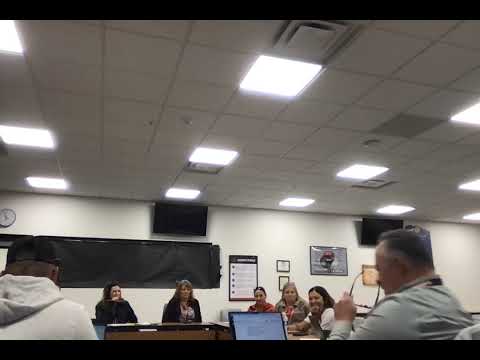
Paraprofessionals and district negotiators met April 13 for a Board of Trustees negotiations session that focused on outdoor-duty scheduling, substitute pay for paras, staffing in behavior/ABA rooms and training incentives.
The meeting opened with the moderator reminding attendees about public-participation rules. Negotiators then turned to outdoor-duty rotation. Participants described varying practices across schools — some use a 20 minutes in/20 minutes out rotation while others reported a lead staffer staying outside for roughly 40 minutes. Staff members asked for a clear option in the agreement allowing employees to choose either the 20/20 rotation or to elect a 40-minute outdoor block, and requested protections for employees with medical challenges. One participant said some staff with conditions such as fibromyalgia find extended outdoor assignments painful and asked that any accommodation option be documented; others cautioned that requiring medical documentation could create unnecessary paperwork or incentives to seek diagnoses.
On substitute coverage, negotiators discussed draft language that would pay a paraprofessional $25 per hour when the para voluntarily substitutes for a teacher. The participants debated administrative and incentive effects of that rate — for example, whether the premium would cause staff to seek substituting opportunities — and emphasized that voluntary coverage should not routinely pull paraprofessionals away from their assigned students, since doing so disrupts continuity of care and instruction.
The group also discussed whether paras may volunteer to cover non-instructional roles such as secretarial duties. Some said earlier guidance had limited that work; others supported voluntary coverage at regular pay as a way to avoid overtime or classification disputes. Participants asked that any language allow volunteering but guard against creating retroactive pay claims.
Safety and staffing in behavior or ABA rooms drew consensus: negotiators proposed explicit language requiring two staff in the ABA/behavior room or equivalent space to ensure student and staff safety. Negotiators said the CBA should use an explicit label ("ABA/behavior room") rather than a vague phrase so expectations are clear.
Training, certification and professional-development issues were also prominent. Members described a 40-hour special-education course completed through Dawson Community College and asked that the certificate be recognized in pay lanes or training incentives. The CBA currently provides 18 professional-development hours; participants discussed modestly expanding or clarifying access to those hours (for example, scheduling some PD on Wednesdays, offering video/makeup options, and providing two weeks' notice for required sessions).
Health-care tasks such as feeding-tube care and toileting generated concern. Participants said nurses historically handled clinical tasks and urged that feeding-tube procedures remain the responsibility of licensed nursing staff; paras might be trained only where appropriate and with parental authorization. Several speakers flagged liability and privacy concerns for intimate-care duties and urged clearer job-description language.
On pay and benefits, negotiators revisited an attendance-incentive pool (participants cited past totals in the roughly $28,000–$42,000 range) and discussed trade-offs between preserving monthly incentives and converting that money into a permanent across-the-board raise. Participants warned that removing the incentive could increase call-outs, and no final agreement was reached at this meeting; insurance changes were noted as pending and will be discussed in a future session.
Negotiators asked each side to draft clarified contract language on outdoor-duty options, substitution/compensation rules, ABA-room staffing, and the scope of clinical tasks. The board work session and next negotiation steps were scheduled; participants set a board work session for April 21 with a tentative afternoon time and agreed to reconvene to exchange written proposals before finalizing changes.
Ending: The meeting closed with negotiators agreeing to refine language for review; insurance and final pay proposals will be taken up at a subsequent session.